Artificial Intelligence in Plastic Waste Sorting: A Revolution You Can't Afford to Miss
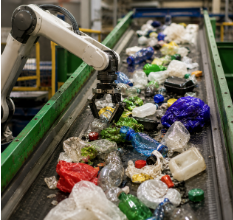
Proper waste separation and sorting is a fundamental pillar for driving the circular economy forward.
At Recircular, we know that when you separate your waste, you do your best to get it right. But it is not always easy. Sometimes, there are so many questions that you end up mixing things that, in plain English, simply don't belong together.
Fortunately, artificial intelligence is helping us correct these mistakes. This is particularly important when dealing with plastic waste. AI, computer vision and robotics are opening up a world of new possibilities that would have seemed unimaginable just a few years ago.
The revolution, however, has only just begun.

The Plastic Waste Problem: Why Do We Need New Solutions?
Plastic has transformed our lives. However, the way we manage plastic waste still leaves much to be desired, and large amounts of plastic end up in our oceans, rivers and soil.
The EU recycles almost 41% of the plastic waste it generates. This figure is not enough when we consider that 55% of plastic packaging will have to be recycled by 2030, in line with the objectives of the European Green Deal.
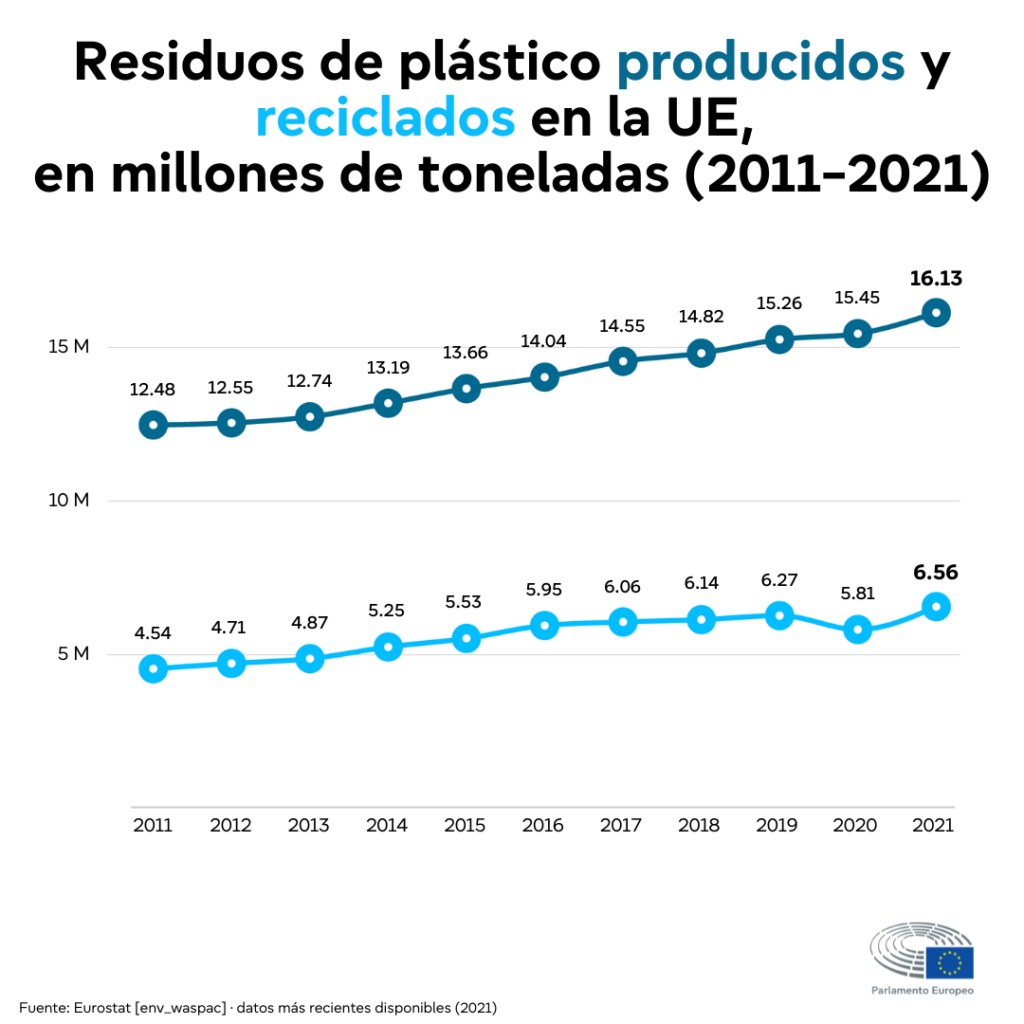
One of the main reasons behind this low recycling rate is the complex composition of plastics. There are many different types of plastic, each with its own properties and specific treatment requirements.
It is also common to find products made from different types of plastic, such as:
- PET plastic containers with a polypropylene (PP) cap and paper or plastic labels, or
- car bumpers made of PP, ABS components, PVC cable coatings, mixtures of plastics and rubber, and so on.
This makes it difficult to identify and separate different types of plastic to ensure they are properly recycled.
But technology and innovation are already playing a key role, improving the sorting of this type of waste.

Artificial Intelligence for More Efficient Plastic Waste Sorting
So, how can artificial intelligence help us? To understand its potential, we first need to look at two key concepts:
Computer Vision: Detecting the Invisible
Thanks to computer vision, machines can “see” in real time, in a way that is similar to how humans perceive objects.
Now, let's apply this capability to waste management. Imagine a waste sorting conveyor belt equipped with cameras using this technology. The result is a system that can scan waste and automatically detect the material it contains.
In fact, companies such as Tomra already market solutions capable of identifying different types of plastic by colour. Their equipment can even distinguish between different polymer types, a task that would be almost impossible to perform manually.
Machine Learning: When Machines Learn Over Time
But if computer vision sounds like science fiction, machine learning is set to transform the way we think about the future. Because machines can now learn too. Just like you.
This learning process is achieved by training machines with large volumes of data. And although this technology is still rapidly evolving, projects such as the one being developed by the National Institute of Standards and Technology (NIST) in the United States have already achieved accuracy rates of up to 98% when identifying certain types of plastic.
“The chemical and plastics industries are undergoing a major transformation. The environmental challenges we face are forcing us to look for innovative and sustainable solutions. In this context, artificial intelligence is emerging as a powerful tool that can change the way we address these challenges.” Alicia Martín, Director General of Plastics Europe in the Iberian region
Robotics: Combining Computer Vision and Machine Learning for Plastic Waste Sorting
Once AI has identified which items are plastic and determined their composition, robotics takes over to carry out the physical separation.
Many waste sorting systems use AI-controlled robotic arms to remove different types of waste quickly and accurately. EverestLab's solution, for example, has an accuracy rate of 95%. In Alameda County, USA, where the system was implemented, it has collected approximately 30 million objects over three years.
What Are the Benefits and Challenges of Using Artificial Intelligence and Robotics in Plastic Recycling?
The sections above make the positive results and potential of these innovations clear.
Their application can lead to:
- Lower costs, as processes become automated and efficiency increases.
- Higher recycling rates thanks to improved sorting accuracy.
- Reduced environmental impact by minimising the amount of plastic waste sent to landfill.
- Greater innovation, with technologies and solutions constantly evolving, and with collaboration between the public and private sectors and between start-ups and leading companies becoming increasingly common.
However, adopting AI in waste management also involves a number of challenges, including:
- High initial costs, which require significant investment.
- A lack of suitable facilities capable of accommodating these technologies.
- Dependence on data, which can be an obstacle to achieving maximum system efficiency.
Towards a Cleaner Future
AI is transforming the way we manage complex materials such as plastic.
Thanks to technology, we can now sort and classify waste with greater speed and accuracy. This possibility not only helps protect the environment but also creates new business opportunities within the circular economy.
One person's waste can be another person's treasure. And thanks to AI, that treasure is closer than ever.
