PVC Recycling: A Solution for a More Circular and Efficient Industry
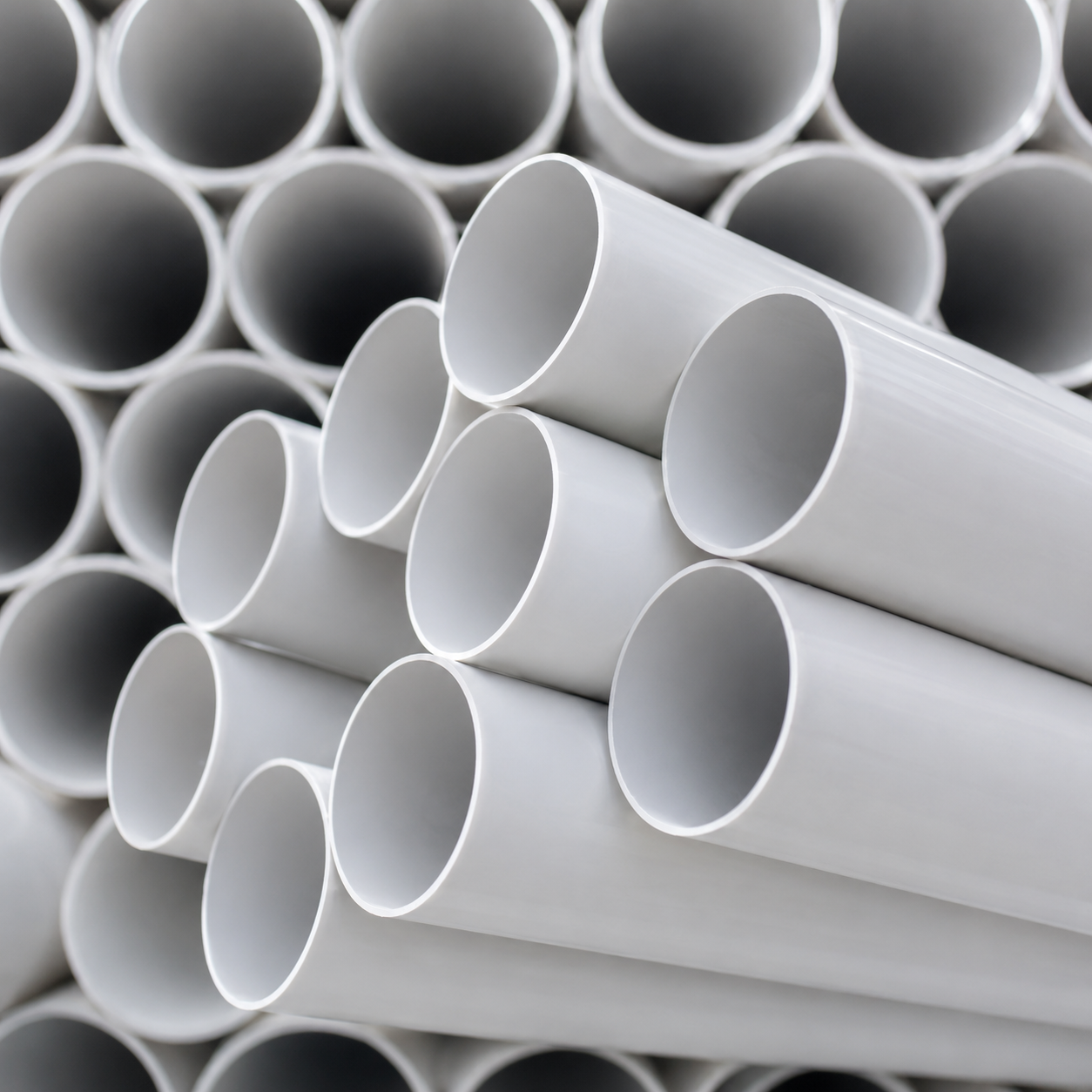
Polyvinyl chloride, or PVC, is one of the most widely used plastics thanks to its durability, versatility and low cost.
Managing PVC waste, however, is a challenge because it can take hundreds of years to degrade if it ends up in landfill. Its chemical composition also poses risks when it is burned without proper control.
Finding a second life for PVC is therefore one of the most effective ways to extend its useful life without harming the environment. It not only reduces waste, but also saves resources and energy by avoiding the production of new virgin material.
The development of innovative projects such as PVC4Cables, together with various private-sector initiatives to recycle PVC and extend its useful life, are helping drive the transition towards a more sustainable model full of opportunities — and a little bit of imagination.
What Is PVC?
PVC is a thermoplastic polymer derived from vinyl chloride and found in a wide range of everyday products. It has been commercially produced since 1933.
It comes in two main forms: rigid PVC, used in window profiles, pipes and conduits; and flexible PVC, commonly used in cable coatings, vinyl flooring and hoses.
Its production is based on two main raw materials:
- common salt (sodium chloride), from which chlorine is obtained through electrolysis, and
- oil or natural gas, from which ethylene is extracted.
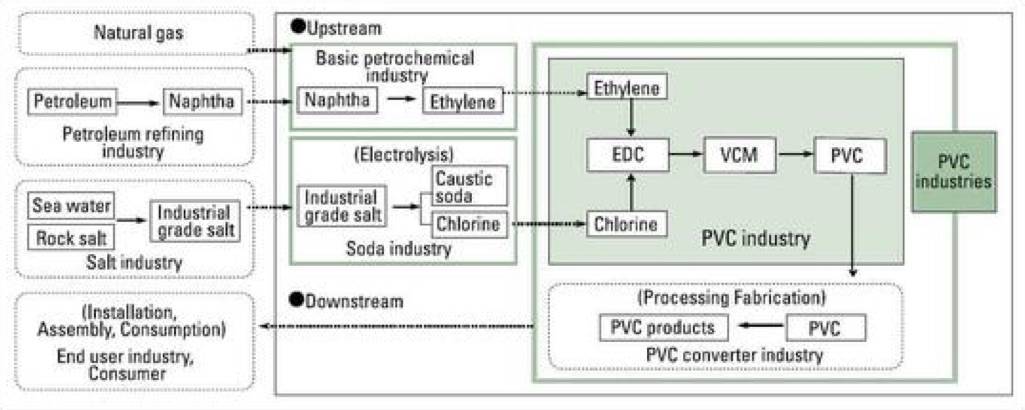
Source: European Council of Vinyl Manufacturers
In terms of composition, approximately 57% of PVC comes from common salt and 43% from oil or natural gas. This makes PVC one of the plastics least dependent on oil.
These two raw materials are combined to produce vinyl chloride, which is then polymerized to form the polymer itself.
How to Give PVC a Second Life Through Recycling
Considering the characteristics and widespread use of PVC — around 20% of all plastics are made up of this material, making it the second most widely used plastic after polyethylene — millions of tons of PVC waste are generated every year.
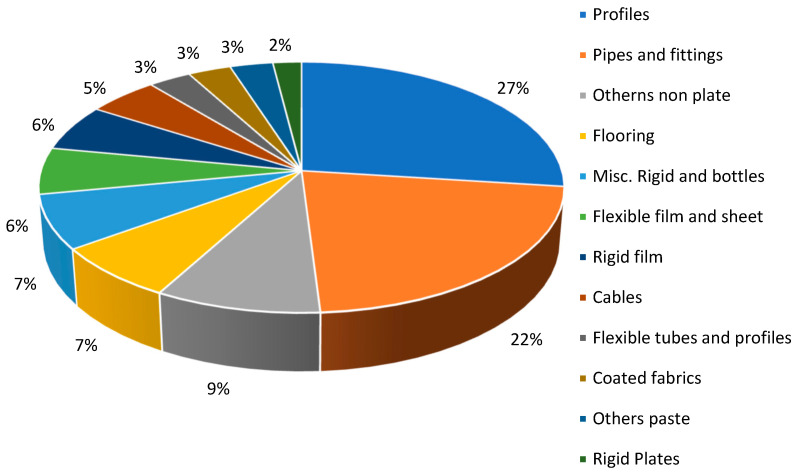
Source: Peti, D., Dobránsky, J., & Michalík, P. (2025). Recent Advances in Polymer Recycling: A Review of Chemical and Biological Processes for Sustainable Solutions. Polymers, 17(5), 603. https://doi.org/10.3390/polym17050603
PVC, however, has a significant advantage over other plastics: it can be recycled multiple times with very little degradation. For example, the process used by Deceuninck enables PVC recycling more than 10 times. If we consider that a PVC window has a useful life of around 35 years, its potential lifecycle could reach up to 350 years.

PVC Recycling Methods
There are different methods for giving PVC a second life, each with specific applications depending on the type and condition of the waste:
- Mechanical recycling is suitable for processing PVC waste through physical processes such as sorting, cleaning, shredding and melting it to manufacture new products. The main limitation of this method is that it is only effective when dealing with homogeneous and uncontaminated waste, such as production scraps, pipes and window profiles.
- Chemical recycling breaks PVC down into its chemical components through processes such as pyrolysis or gasification. It is particularly suitable for complex or contaminated waste.
- Other emerging methods include solvent-based recycling, which purifies PVC by separating it from additives and contaminants, and biological or enzymatic degradation, which uses microorganisms and enzymes to break down PVC, although these technologies are still at the research stage.
| Method | Key characteristics | Suitable for | Main challenges |
|---|---|---|---|
| Mechanical recycling | Physical reprocessing | Clean and sorted waste | Less effective with contaminated or mixed waste |
| Pyrolysis | Thermal decomposition and HCl recovery | Mixed or contaminated PVC | Chlorine management and high energy consumption |
| Gasification | Conversion into syngas and chlorine recovery | Diluted or complex waste | High energy requirements |
| Dechlorination | Chlorine removal and HCl production | PVC with high chlorine content | Requires additional processing |
| Chlorine recovery (RecoSalt/RecoAcid) | Recovery of chlorine and metals | Difficult-to-recycle PVC | Requires specialized facilities |
| Supercritical CO₂ extraction | Removal of plasticizers from PVC | Flexible PVC products | High pressures and temperatures |
| Solvent-based recycling | Dissolution and purification of PVC | PVC containing additives | Solvent recovery and scalability |
| Biological/enzymatic degradation | Use of microorganisms or enzymes | Experimental applications | Not yet commercially available |
Source: own elaboration.
Industrial Models and Initiatives Leading the Way
PVC recycling methods are being put into practice through numerous projects around the world.
- The Fraunhofer IVV (Institute for Process Engineering and Packaging) research center has developed a process based on solvents that separate aluminum from PVC in products such as pharmaceutical blister packs.
- The European Council of Vinyl Manufacturers (ECVM) works on several fronts, developing programs such as VinylPlus, which aims to establish a long-term framework for the sustainable development of the PVC industry; PVCMed Alliance, focused on raising awareness of PVC use in healthcare; PVC4Cables, which aims to promote sustainable innovation in PVC cables; and PVC4Pipes, focused on the use of PVC in pipes.
- Gerflor, a company specializing in flooring and vinyl coverings, has launched the Second Life initiative, through which it recycles PVC from its facilities.
How to Manage or Sell PVC for Recycling
Giving PVC a second life does not depend solely on the technology available. It also requires proper waste management to ensure that the material can be reintroduced into the production chain.
In this regard, specialized platforms and operators that buy or collect PVC waste for recovery play an important role. At recircular, for example, we connect companies that can give PVC a second life with those that generate it.
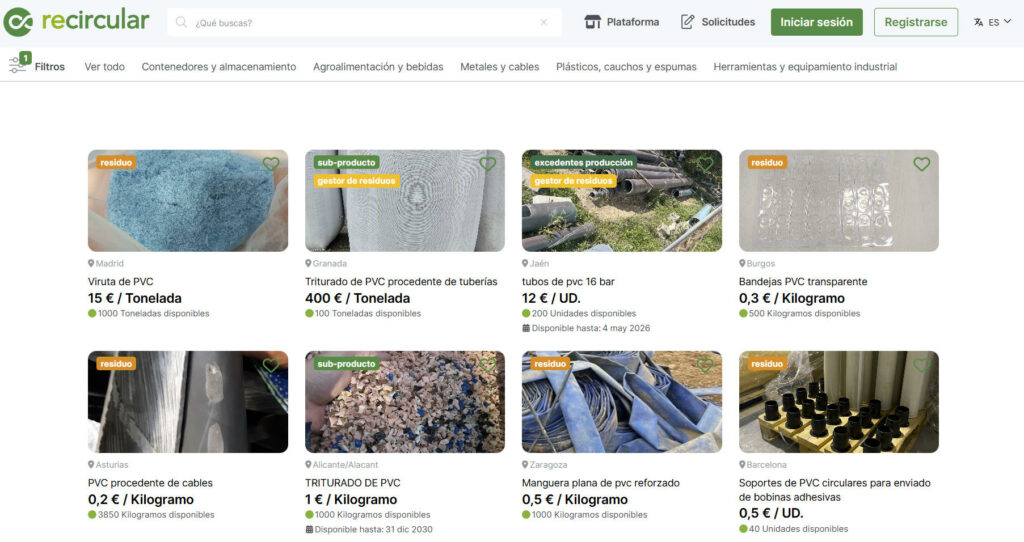
Source: recircular recovery platform (29/05/2025)
Our AI-powered algorithm makes material exchange easier, optimizing resources, reducing waste management costs and helping companies generate the necessary waste documentation in a simple way.
A Second Life for PVC: The Choice of an Industry Embracing the Circular Economy
Giving PVC a second life is not just a responsible choice. It is also an opportunity because recycling PVC can reduce costs, minimize waste and strengthen the commitment to a more sustainable production model.
Current technologies, together with platforms such as recircular, are helping more and more companies discover the potential of PVC within a circular strategy. With proper management, this material can remain in use for many years, contributing to a more efficient and environmentally responsible economy.
What's more, our platform features several companies specializing in PVC recycling that we can connect you with if you want to give your PVC waste a second life.
Because giving value to what was once considered waste is no longer just a trend.
It is competitiveness.
