2025, a key year for moving towards more sustainable waste management
At the beginning of the year, everyone, more or less, makes a list of New Year’s resolutions. At Recircular, we are no exception. So this year, one of our goals is to contribute to achieving sustainable waste management.
We have therefore decided to start 2025 by identifying some of the key trends that will transform waste management this year. Some of them have already been implemented on our platform, while others are emerging strongly. But all of them are set to help shape a more sustainable future.

Why do we need sustainable waste management?
Because we generate an enormous amount of waste. According to Eurostat data, each European citizen generated 5 tonnes of waste in 2022. In total, more than 2.2 billion tonnes of waste were generated, of which around 2 billion tonnes were treated (excluding waste exported to countries outside the EU).
The following figure shows the contribution of different economic activities and households to total waste generation.
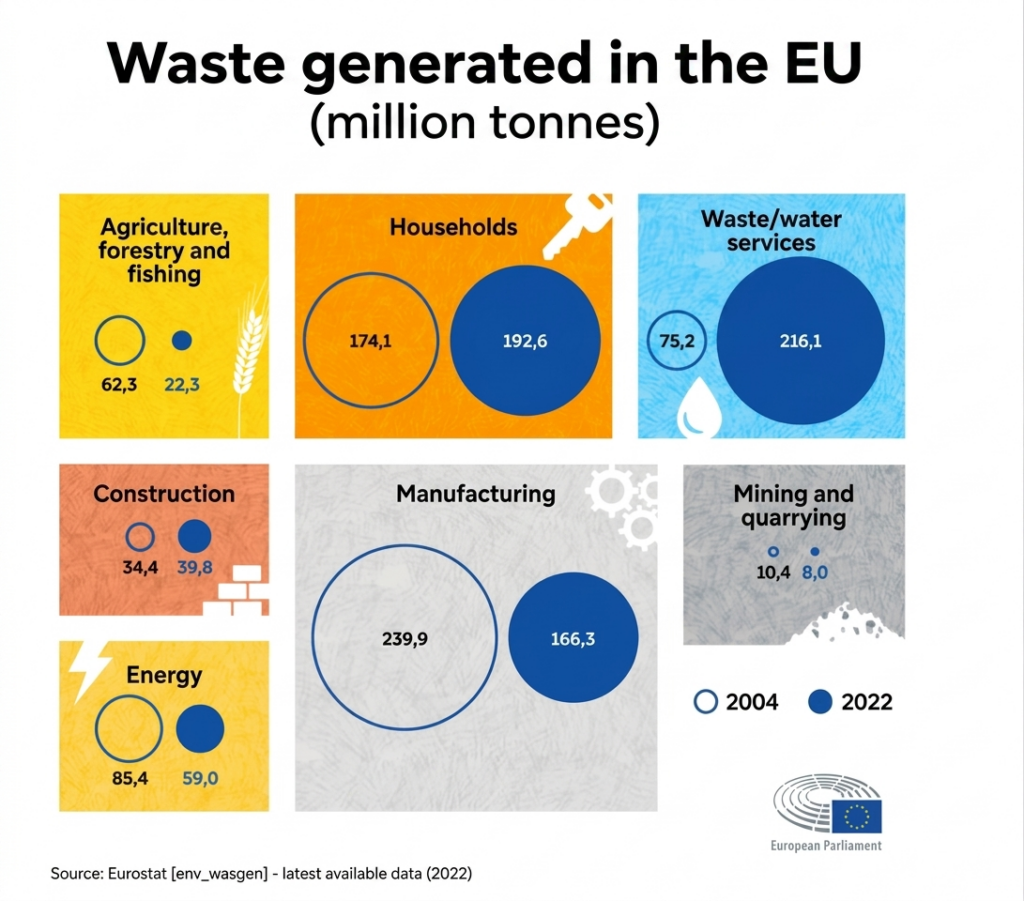
Source: The EU’s work towards sustainable waste management. European Parliament, April 2018 (updated March 2024).
Can we afford the environmental, social and economic cost of ignoring the problem caused by this huge volume of waste? The answer is a resounding no. After all, failing to implement sustainable waste management means:
- increasing pollution;
- depleting natural resources; and
- increasing the economic costs associated with environmental damage.

How can we move towards more sustainable waste treatment?
The problem is clear. But we have access to more efficient management models and technologies that can help us improve the management of municipal and industrial solid waste, while also creating interesting business opportunities.
What trends do we see in this area that could represent a turning point in 2025?
5 sustainable waste management trends to watch
We don't have a magic mirror that can tell us which waste-related topics will be key during 2025. But after several years working in the circular economy sector, we can identify some clear development trends that are gaining momentum, whether driven by regulatory requirements or efficiency needs.
Extended Producer Responsibility (EPR)
Extended Producer Responsibility (EPR) is a regulatory approach that requires manufacturers, importers and distributors to take responsibility for their products throughout their entire life cycle, including the waste generated after they are used.
One of the main developments in 2025 is the entry into force of the various obligations established by Royal Decree 1055/2022 of 27 December on packaging and packaging waste. Since 1 January, all packagers, importers and purchasers of packaged products intended for the Spanish market are required to establish an individual extended producer responsibility scheme (SIRAP) or join a collective extended producer responsibility scheme (SCRAP).
This trend will almost certainly drive policies focused on waste separation, a fundamental step towards promoting sustainable waste management.
More circular economy
As we discussed when analysing Recircular’s milestones in 2024, we would like circularity strategies to continue growing. We are convinced, however, that this year we will continue making progress in demonstrating to companies the benefits they can gain by adopting strategies based on reducing, reusing and recycling.
In fact, our platform is a clear reflection of the growing importance of waste recovery and valorisation. So we have no doubt that during 2025, strategies built around these 3 pillars of the waste hierarchy on which the circular economy is based will continue to strengthen.
At Recircular, we can help you put policies aimed at achieving these objectives into practice, so don't hesitate to contact us if you would like to find out how.
Reuse to the fullest
Although reuse is one of the "legs" of the circular economy mentioned in the previous section, we want to give this practice special attention, as its growth is consolidating year after year. This is something we have seen first-hand at Recircular: in 2023, 13% of the waste that passed through our platform was destined for reuse, while in 2024, the percentage rose to almost 100%.
These figures cannot, of course, be extrapolated to the market as a whole. However, they suggest that interest in second-hand products is gaining ground in the market. After all, why recycle a used product if it can be reused?
Technological innovation
The use of IoT sensors, artificial intelligence and advanced monitoring systems is transforming the way waste is managed. These technologies make it possible to optimise collection routes, automatically sort waste and improve energy efficiency at treatment plants. The new version of our platform is an example of how these advances are increasing efficiency and improving traceability.
AI, together with data analytics, also promises to revolutionise current waste treatment systems by developing solutions such as predictive waste management.
Fewer packages and packaging that is easier to reuse and recycle
The new European regulation on packaging and packaging waste, published on 22 January, will pave the way towards more sustainable packaging through new regulations that will transform its design, use and recycling. By 2030, all packaging must, in fact, be reusable or recyclable, with ambitious recycling targets set for 2035.
Among the key measures are:
- the introduction of minimum recycled content targets;
- restrictions on harmful substances such as PFAS;
- bans on certain single-use plastics;
- reductions in the weight and volume of packaging; and
- the implementation of deposit and return systems for beverage containers.
Regarding the latter, we cannot close this article without mentioning the recent approval of the Deposit, Return and Refund System (SDDR), which will be implemented in Spain during 2026 and was already expected to generate significant discussion throughout 2025. At Recircular, we welcome this decision, as we believe it could represent a decisive step towards improving packaging recovery and recycling rates in Spain.
Sustainable waste management starts with a first step
Sustainable waste management is not only an environmental necessity, but also an opportunity to drive innovation and the circular economy.
In 2025, trends such as digitalisation, waste separation, packaging treatment, reuse and the implementation of Extended Producer Responsibility (EPR) will shape the path towards a more sustainable future.
However, success will depend on collaboration between governments, businesses and citizens, as well as a commitment to responsible policies and practices.
At Recircular, we are committed to driving this transformation and provide the tools and expertise needed to make it happen.
If your company is ready to be part of the change, contact us and discover how we can help you implement sustainable and efficient waste management.
