Success Stories at recircular: How Industrial Companies Find New Uses for Containers and IBCs
One company has dozens of unused IBCs sitting in its warehouse. Another, just fifty kilometres away, has just ordered new ones from its supplier.
This mismatch happens every day. And it comes with a cost that few companies calculate properly: warehouse space occupied, waste management costs, and the purchase of new equipment that already existed just a few kilometres away.
The reason is structural. Until recently, the second-hand market for industrial containers was opaque and difficult to access. Without visibility into who has what, or guarantees regarding the condition of the material, buying new has always been the default option.
In this article, we look at how companies in the industrial sector are changing this logic through recircular, with a real-life example.
What containers and boxes are traded on recircular?
The containers and storage category on the platform includes a wide variety of used and reusable materials:
- Metal boxes and cages
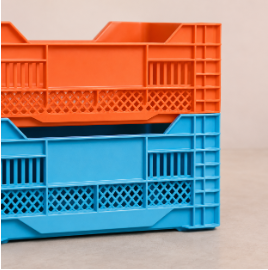
- Open, collapsible and stackable plastic boxes
- Magnum boxes
- Fibreglass tanks
- 200-litre drums
- 1,000-litre GRGs and IBCs, both dirty and clean and ready for reuse
- Big bags
- Jute sacks
These materials come from companies in sectors such as food and beverage, chemicals, logistics, agriculture, construction, and plastics and rubber manufacturing. In some cases, they are completely clean; in others, they contain small amounts of non-hazardous product residue and can still be perfectly reused.
On the other side of the transaction, typical buyers include construction companies working on-site, warehouses, logistics operators, and agricultural and livestock businesses.

Why do industrial containers end up sitting unused?
Plastic containers and boxes have a long useful life. They are designed to withstand intensive use, temperature variations, heavy loads and mechanical handling.
But production flows change. A company may redesign its processes, close a production line, change suppliers or reduce its stock levels. Suddenly, it may have dozens or hundreds of units it no longer needs, taking up space with no clear outlet.
At the same time, another nearby company may have just ordered the same items new. Without a channel connecting these two situations, the surplus sits unused while the purchase is made as usual.
The usual options — and why they fall short
When we talk to companies generating this type of surplus, they usually describe three possible outcomes:
- Waste managers or intermediaries, when the volume is significant.
- Storage with no end date, waiting for an opportunity to arise.
- Direct offers to industry contacts, with varying results.
In some cases, especially with big bags and similar materials, the end destination is simply the waste container. Not because the material has no value, but because it takes up too much space and nobody has the time to find it a new use.
What is missing in all these scenarios is a structured marketplace: a place where companies with surplus materials can publish detailed information, and those who need them can find them without relying on two companies already knowing each other.
Real case: how a food company found a new outlet for its big bags
Starting point. A food company was accumulating dozens of big bags every month that had previously contained powdered ingredients. They contained small amounts of non-hazardous product residue, but were taking up a significant amount of warehouse space.
How they managed them before. The usual practice was to roll them up to reduce their volume and throw them away. The material accumulated for weeks until the available space was exhausted, at which point it had to be dealt with urgently: without recovering any economic value and with an associated waste management cost.
What changed after using recircular. They published the big bags with details of their previous contents, quantity, condition and photographs. The AI algorithm automatically notified regular buyers of this type of material — in this case, construction and agricultural companies — and they received an enquiry within a few days. They approved the transaction, arranged transport through the platform and completed the transaction with the payment held in escrow until the buyer confirmed receipt.
What had previously been a recurring cost became a transaction completed within days, with the material given a new outlet, warehouse space freed up and value recovered.
How the process works on recircular
The process is straightforward and requires no integrations or changes to the company's internal processes. It takes seven steps:
- 1. Free registration and listing. Publish the material in just a few minutes, including its description, photographs, condition, quantity and price.
- 2. Automatic AI notifications. The algorithm matches the listing with user profiles and alerts potential buyers who may be interested.
- 3. Internal messaging. Sellers and buyers can resolve questions directly through the platform, while maintaining confidentiality for both parties.
- 4. Purchase request or offer. The buyer specifies the quantity and transport requirements. If they want to negotiate the price, they can submit an offer.
- 5. Approval and transport management. The seller approves the transaction and, where applicable, can request a transport quote through the platform.
- 6. Secure payment. The buyer pays in advance and the amount is held by recircular until the buyer confirms receipt of the material.
- 7. Support throughout the process. We support every transaction by phone, WhatsApp or email whenever needed.
The result: the seller knows that payment is secured, while the buyer knows that the money will not be released until they have received and approved the product.

What do companies gain by managing boxes and containers this way?
Companies that integrate this approach into their day-to-day operations stop treating containers as a linear expense and start seeing them as assets with market value:
- Economic value recovery. Surplus material stops being a cost and starts generating revenue.
- Freed-up warehouse space. Less accumulation, better stock rotation and fewer last-minute situations.
- A network of more than 1,000 companies. Producers and waste managers across Spain, without relying on a single supplier.
- Traceability and confidentiality. Every transaction is recorded while protecting sensitive data.
- Secure payment. Paid in advance and held until the buyer confirms receipt.
- Environmental and social impact reporting. Useful for non-financial reporting, ESG and circular economy reporting.
- No integrations required. Publish in minutes without adapting processes or installing anything.
This approach also ties in with a structural advantage of reusable containers. According to Embamat, although the initial investment is around €15 per unit compared with €0.50–€1.50 for a cardboard box, the cost per trip drops dramatically after 50 uses. Buying second-hand through recircular improves this equation from the very first cycle: a lower upfront price with the same useful life ahead.
Best practices for listing containers on recircular
How you list your material can make the difference between a quick transaction and a listing that generates little interest. Four practices that work:
- 1. Group materials by type and condition. A homogeneous batch of boxes, big bags, IBCs or other containers with the same capacity and previous use is much easier to place than a mix of unrelated items. Buyers need to know that the material will fit their operations.
- 2. Document previous use. You do not need a technical report unless you already have one or the product requires it, but you should state what the container previously held, how many cycles it has completed and whether it has undergone cleaning or sanitisation. This information reduces friction and speeds up the transaction.
- 3. Publish regularly, not only when you're running out of space. Companies that treat the platform as a regular channel for disposing of surplus materials manage warehouse space more effectively and obtain better conditions than those that only publish when they are under pressure.
- 4. Don't reject material based on appearance. An IBC showing signs of use may still be perfectly operational. Industrial buyers know this; what they need is accurate information, not perfect appearance.
Surplus is also a resource
Industrial containers are not a warehouse problem. They are assets that have a market when properly managed.
The logic is simple: if the material is in good condition and someone needs it, the only reason it should end up as waste is that there is no channel connecting the two sides.
That channel exists. It's called recircular.
