Stages of Industrial Waste Management: From Source to Recovery
For years, managing industrial waste came down to a single question: who is going to take it away? Finding an authorised waste manager, signing the paperwork and moving on was often enough.
Not anymore. Law 7/2022 and the State Framework Plan for Waste Management (PEMAR) 2025–2035 have redefined the stages of industrial waste management to promote resource recovery and valorisation. Traceability and the systematic recording of every movement, for example, are no longer optional but a structural requirement of industrial waste management in Spain.
The waste hierarchy: the framework that guides every stage
Not all waste management options carry the same weight. Law 7/2022 establishes a clear order of priority in Article 8:
- Prevention.
- Preparation for reuse.
- Recycling.
- Other forms of recovery, including energy recovery.
- Disposal.
This is known as the waste hierarchy, and it is the principle that should guide every decision, from the design of the production process to the choice of final treatment.
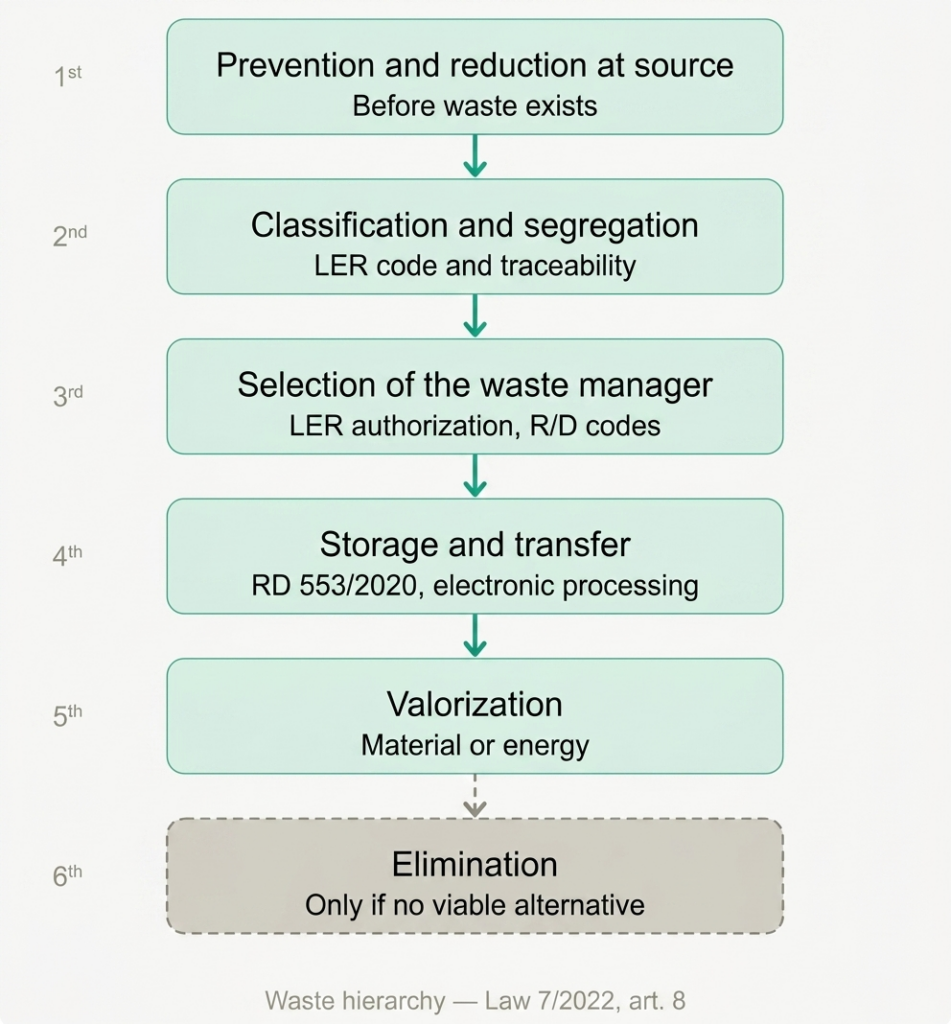
Source: own research based on Article 8 of Law 7/2022.
Stages of industrial waste management: from prevention to final treatment
Every industrial waste stream follows a journey. The stages of industrial waste management are not always linear or end in the same way, but they are all defined, regulated and increasingly digitalised.
Understanding them is the difference between managing waste because you have to and managing it strategically.
Prevention and source reduction
The first stage begins before the waste even exists.
Prevention means acting on the process: reviewing product design, replacing problematic raw materials, optimising maintenance and reducing production losses.
This is not just a matter of good intentions. The PEMAR 2025–2035 strengthens prevention and recovery across industrial waste streams, while waste legislation requires hazardous waste producers to implement waste minimisation plans that must be reviewed every four years (Article 18 of Law 7/2022).
Digitalisation is particularly useful at this stage, enabling more accurate control of inventories and processes and directly reducing the amount of material that ends up being classified as waste.

Classification, segregation and traceability of industrial waste
Proper source segregation determines everything that comes afterwards.
Each waste stream must be identified according to its nature and hazardousness and assigned its EWC code. This six-digit system, mandatory throughout the EU, determines how the waste must be stored, transported and treated. Incorrect classification can lead to inappropriate treatment and, in addition, to regulatory breaches that may result in penalties.
Industrial waste traceability is the tool that makes the entire process auditable. And it starts here, when the company identifies what it has, in what quantity and with what characteristics.
Our recovery platform also makes it possible to match this information with demand from other companies, turning what appeared to be waste into a resource with a real outlet.
Finding and selecting industrial waste managers
Not every waste manager is suitable. The one offering the lowest price or the one you already know is not necessarily the best choice. The waste manager must be authorised to handle your waste's EWC codes, demonstrate which recovery or disposal operation they will carry out (using R and D codes), and adjust collection frequency to the actual needs of your facility.
A reliable indicator that a waste manager is properly authorised is their ability to generate all the required waste management documentation. At recircular, we facilitate this through Teimas, our partner specialising in documentary traceability. If a waste manager cannot provide this documentation, it is a warning sign.
As for pricing, some waste streams will generate income for you (metals and certain plastics, for example), while others will involve a cost. What matters is that the operation is transparent and the final destination can be verified.
Storage and transportation of industrial waste
While waste is waiting at your facility, requirements relating to labelling, containment according to hazardousness and maximum temporary storage periods apply.
When the waste leaves the facility, Royal Decree 553/2020 comes into play, regulating the transportation of waste within Spain. It requires prior notification, a treatment contract with an authorised waste manager and an identification document that accompanies the waste throughout the journey.
The process is electronic, through the eSIR system or equivalent regional platforms, strengthening traceability and facilitating oversight by the competent authorities.
Industrial waste recovery: the priority destination
When waste cannot be prevented or directly reused, the priority is to recover it.
In practice, this means mechanical recycling, metal recovery, solvent regeneration or reincorporating materials into production chains as secondary raw materials.
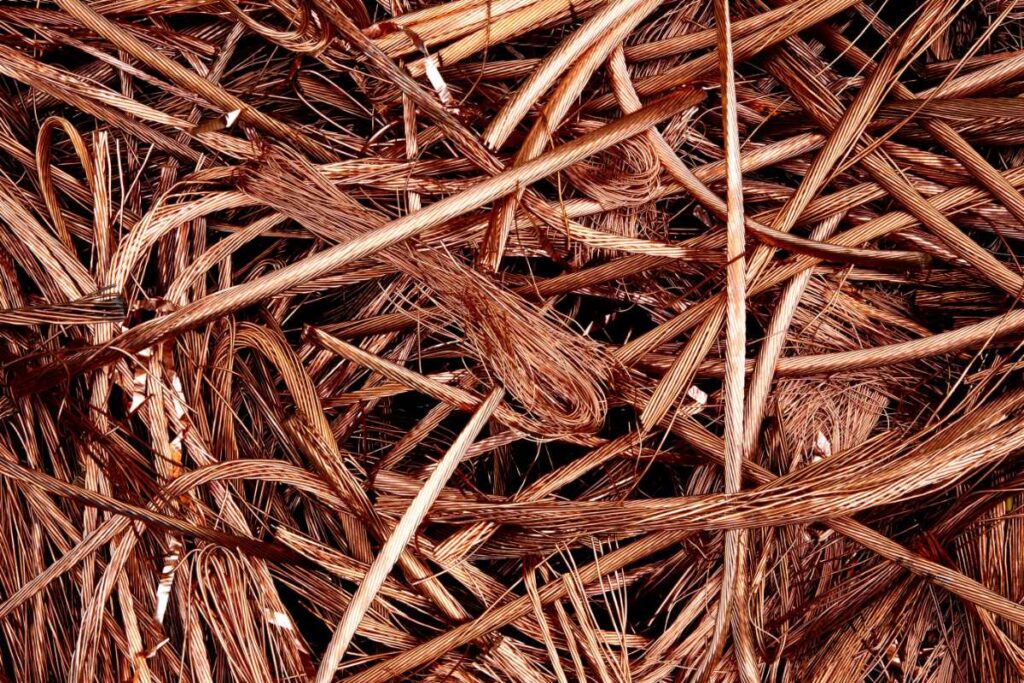
Source: Alex Tepetidis, 2020.
The PEMAR 2025–2035 recommends establishing new recovery targets for industrial waste streams and promotes industrial symbiosis: integrating one company's waste and by-products as resources into another company's production processes, promoting cross-sector circularity.
This is exactly what recircular facilitates by connecting material flows between companies with digital traceability.
For complex waste streams or materials without a viable recovery route, energy recovery options such as pyrolysis or gasification are available, although technical and economic challenges still limit their large-scale application.
Landfill disposal remains the last resort, to be used when none of the previous alternatives is technically or environmentally viable. The legislation establishes this hierarchy, and the regulatory trend is towards progressively increasing the cost of this route.
Industrial waste management no longer ends at the bin
Preventing, classifying, finding waste managers, tracking, transporting and recovering waste… each stage has its own rules, deadlines and opportunities.
Companies that understand this journey can avoid penalties and reduce costs, while strengthening their environmental positioning and turning what was once a waste management problem into a resource with real value.
