Recycled Plastic in Industry: From Waste to Resource with Traceability
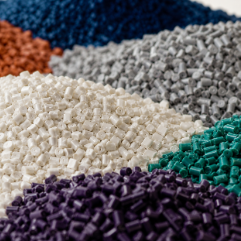
Recycled plastic in industry has an identity problem. Or, more accurately, a problem of knowing what to do with it.
Production offcuts and leftovers, out-of-specification rolls, unused sacks or foam from a cancelled order are all materials that were once raw materials and are now piling up in a corner.
That is where the greatest inefficiency lies.
But it is also an opportunity waiting to be unlocked.
Post-industrial and post-consumer plastic: a distinction that matters
Not all recycled plastic is the same, and the distinction matters more than it might seem.
Post-consumer plastic, the material that comes from household recycling collection, requires cleaning, sorting and intensive processing before it can be reincorporated into a production process.
Post-industrial plastic, also known as pre-consumer plastic, is generated during manufacturing processes themselves: injection moulding sprues, film offcuts, production surpluses, materials that have never reached the end consumer, etc. Its origin is known, its composition can be controlled and, in most cases, it is clean.
In some cases, it can be reintroduced directly into the same production process or processed into plastic pellets, small granules measuring between 3 and 5 millimetres that are the standard format for plastic raw materials, with minimal prior treatment.
This makes it the easiest plastic stream to recover across the entire value chain. And, paradoxically, one of the least effectively utilised.
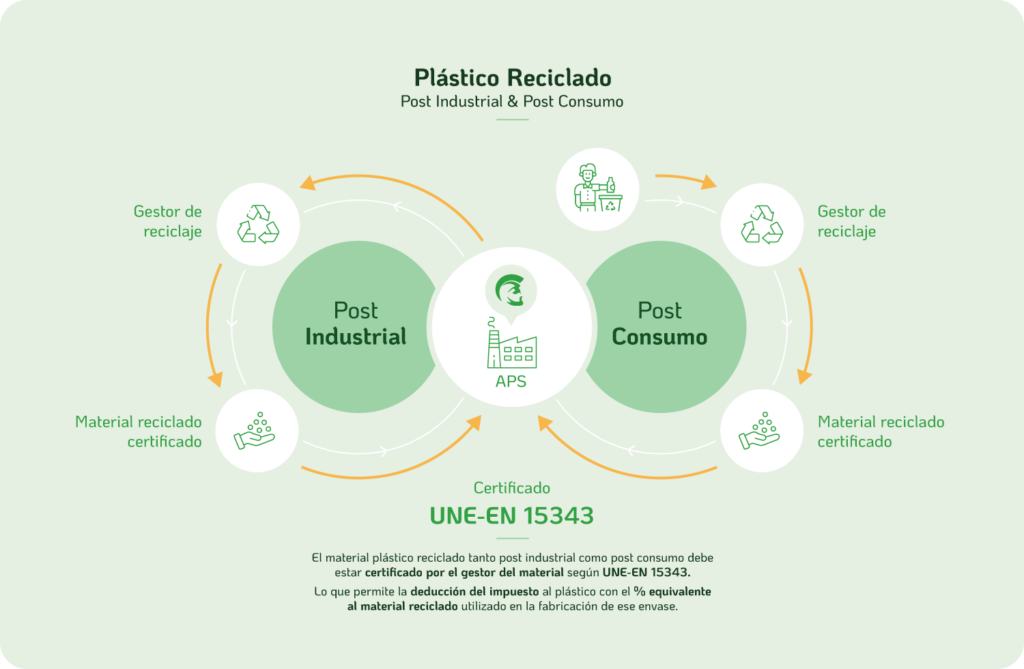
Source: Alcion, April 2024.
Why recycled plastic makes economic sense for industry
Using recycled plastic has a positive impact across three dimensions.
The first is economic. For the seller, a production surplus or out-of-specification material can become a source of revenue. For the buyer, purchasing secondary raw materials from industrial sources can often mean direct savings compared with virgin material, with immediate availability and without the manufacturer lead times that can now stretch to several weeks.
According to a 2026 KPMG study on automotive and manufacturing companies, the main internal driver for adopting circular strategies is cost savings.
The second is environmental. Every tonne of plastic that is reused or recycled instead of being produced from scratch reduces pollution of soil, water and marine environments from waste that can persist for hundreds of years. In 2023 alone, Spain's plastics recycling sector avoided more than 2 million tonnes of CO₂ by replacing virgin raw materials, equivalent to taking more than 1.28 million vehicles off the road.
The third is social. The recycling sector creates local jobs that are difficult to relocate elsewhere. According to the European Parliament, the transition towards a circular economy could create up to 700,000 new jobs in the EU by 2030. In Spain, estimates point to 160,000 jobs if recycling rates increase and circular practices become established across key sectors.

What industrial plastics are available through recircular?
The best way to understand how the recycled plastic market works in industry is to look at what is actually available right now. On our recovery platform, we have plastics from different sources and intended for a wide range of uses.
Enter your search in the top search bar or browse our categories, where you can find PET, PP, PVC, rubber, polyurethane foams and other materials.
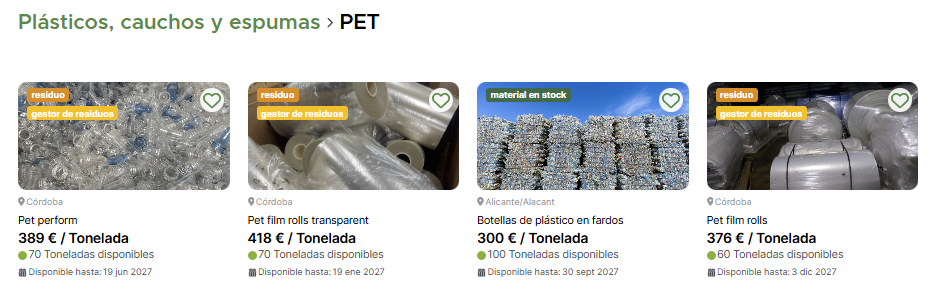
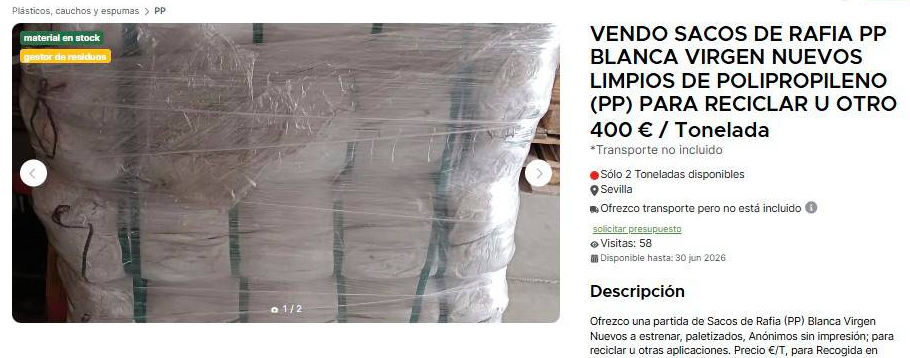
To give a few examples, we currently have clean, unprinted polypropylene (PP) woven sacks. They can have a second life as industrial or agricultural packaging. If they are not suitable for direct reuse, they are a clean feedstock for producing PP pellets, with applications in the automotive, agricultural and construction sectors.
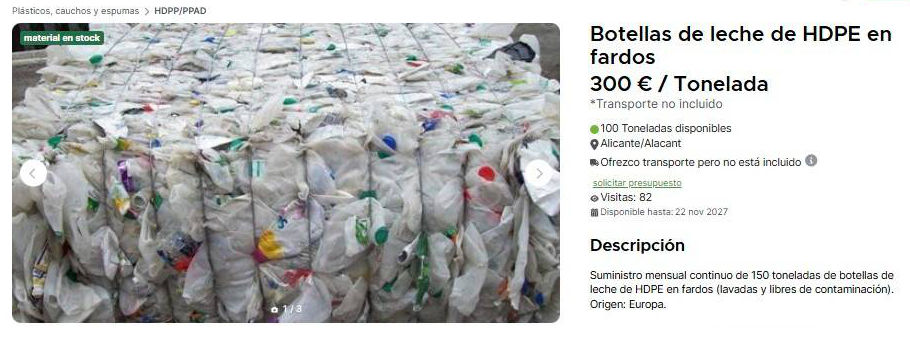
And then there is a higher-volume stream: HDPE milk bottles in bales, with a regular supply of 150 tonnes per month. High-density polyethylene is in demand for manufacturing pipes, profiles and sheets for construction, as well as agricultural applications.
Recycled plastic has a market, but it needs to be connected
Spain has the largest installed plastics recycling capacity per capita in Europe, according to ANARPLA. Every tonne of plastic recycled instead of being produced from scratch avoids between 1.5 and 3 tonnes of CO₂ and reduces environmental pollution.
And yet, in 2024, sector growth was virtually flat.
One of the reasons is structural: the secondary raw materials market is fragmented. Not only because companies operate in isolation, but also because the lack of common criteria defining when recycled material ceases to be waste and becomes a raw material again has disrupted the European internal market.
However, things are changing. In March 2026, the MITECO gave the green light to 115 projects under the Circular Economy PERTE.
But the connection problem remains.
And that is where recircular comes in. Our platform connects companies with plastic surpluses, by-products or waste with other businesses that can put them to use, providing digital traceability for each exchange.
Not every material that can still be useful needs to be handled by a waste management company.
Sometimes, all you need is to know where the material is and who needs it.
