Public administration and the circular economy: keys to driving sustainable transition

Few entities have as much power to accelerate the circular transition as the Public Administration.
It regulates, plans, finances and, in addition, buys a lot. Public procurement accounts for around 14% of the EU's GDP, some £2.4 trillion per year.
And yet, most public institutions continue to buy as if the linear model were eternal.
How public administration and the circular economy can move forward together
When we talk about public administration and the circular economy, we are not talking about a single thing. To understand it better, it is worth distinguishing between two aspects:
- What the administration can do externally: legislate, provide incentives, purchase using circular criteria, etc.
- What it can do internally: manage its own resources, waste and assets using the same logic that it demands of the private sector.

Outward: regulate, incentivise and purchase using circular criteria
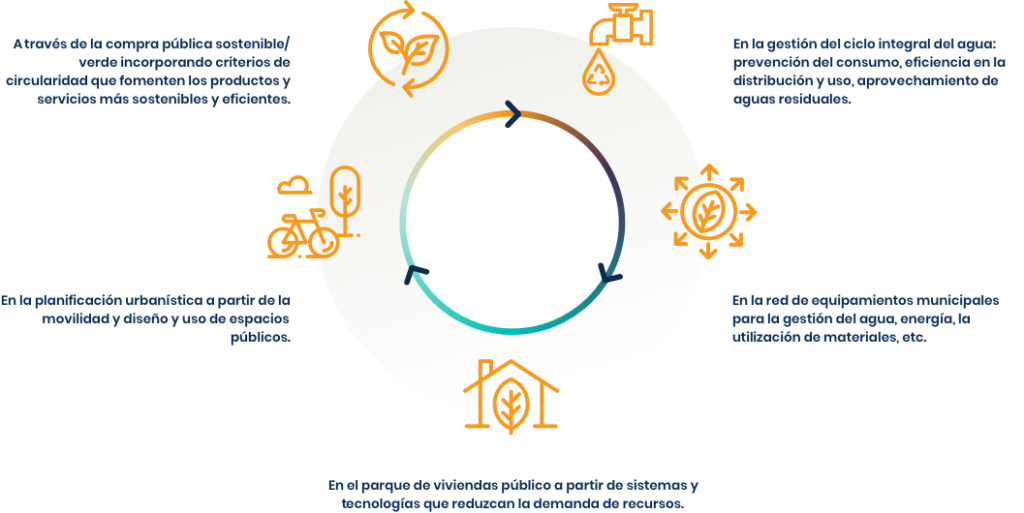
Public institutions have real tools at their disposal to promote circularity beyond their own walls. Green and circular public procurement allows life cycle criteria, recycled content, durability and reparability to be incorporated into any contract specifications. European guidelines already exist, models are documented and the legal framework allows for it.
Some regional administrations have been demonstrating this for years. The Basque Country's Green Procurement and Contracting Programme, for example, integrates the circular economy into its strategic priorities. It is an example of how, with political will and a clear plan, green public procurement ceases to be a goal and becomes routine.
Taxation is another underused lever. Property tax or business tax rebates for companies that commit to industrial symbiosis, landfill taxes that make disposal more expensive than reuse, and incentives for repair are instruments that many municipalities have at their disposal but rarely activate in a coordinated manner. We can also mention an old demand, such as the establishment of a green VAT to promote circularity, although its discussion falls within other national and European spheres as it is a state tax.
The Spanish Circular Economy Strategy, España Circular 2030, sets the national framework, but actual implementation is carried out by local and regional administrations. Some, such as the Regional Government of Castile-La Mancha, have already developed municipal roadmaps that range from situation analysis to results monitoring, including interaction with the local business community.
Internally: managing your own resources with the same logic
Demanding circularity from companies while the administration itself manages its assets in a linear fashion is, at the very least, contradictory.
What happens to office furniture when it is replaced? What about computer equipment? How many public entities have a real inventory of what they have sitting idle and what could have a second life?
Probably very few.
The transition from product to service is another change that administrations can lead by simply changing how they write their specifications. Contracting printing instead of printers or lighting instead of light fixtures does not require an additional budget, but rather a different approach.
The manufacturer retains ownership, has incentives to extend the useful life of the equipment and removes the components at the end of the cycle. The administration reduces waste and simplifies management. It is a change of approach, not of budget.
But for this to happen, someone within the organisation has to understand it, want it and know how to implement it.
Two city councils that have already made a move
Two Spanish cities prove that this is not just theory.
The City Council of Vitoria-Gasteiz is an example of external action. Through its Green Pact Community, a network of local companies committed to sustainability, the council provides free access to the recircular platform to all member companies.
The model is straightforward:
- Companies register resources they no longer use (machinery, materials, production surpluses, etc.), and
- the platform connects supply and demand using artificial intelligence, calculates the environmental impact of each transaction, and generates monitoring reports.
The council assumes the management cost, and the local business community reduces waste, improves efficiency, and has concrete metrics to justify it.
To illustrate internal action, we look at the experience of Málaga City Council. Its Circular Economy Strategy, approved in February 2025 with a horizon of 2030, combines external and internal actions. Among the latter, the following stand out:
- an institutional waste prevention and management plan that functions as an internal pilot;
- the incorporation of circular economy content into the municipal training plan; and
- the identification of employees who act as facilitators of these practices in their departments.
Two councils and two different approaches that share the same conclusion: circularity does not wait for the perfect project.
The path has been laid out, and now all that remains is to follow it
Circularity does not require public institutions to reinvent the way they operate overnight. It requires consistency, ensuring that the same logic promoted externally is also applied internally.
Vitoria-Gasteiz and Málaga are demonstrating this from different angles. The inventory of assets, the review of contract specifications and the search for alliances with platforms such as recircular are concrete steps that any local council, provincial council or regional ministry can take today.
The opportunity is there for anyone who wants to take it.
