Polyurethane Foam Reuse and Recycling: From Waste to Sustainable Solution
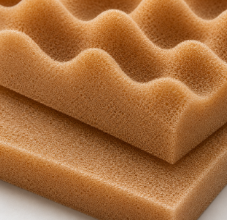
Do you remember those old yellow foam mattresses that used to be found in almost every home?
That easily recognizable material is none other than polyurethane foam, one of the most versatile plastics around us. And although its use in mattresses may have been replaced by other materials over the years, it remains a key component of our everyday lives.
Polyurethane foam is, in fact, a basic component in many types of furniture (sofas and armchairs, car seats, etc.), household appliances and building insulation systems.
But its success is also its greatest challenge, as millions of tons of this material end up in landfills or are incinerated due to poor waste management and historical limitations in its reuse and recycling.
In this article, we will delve into the world of recycled polyurethane foam and explore how science, innovation and collaboration are transforming this problematic waste stream into a sustainable solution. And yes, we are also going to show you some projects that are paving the way towards a truly circular economy.
Because at recircular, we believe the future is not about throwing things away, but about reinventing them.
Ready to discover how?

Why Is It Important to Find Innovative Uses for Recycled or Reused Polyurethane Foam?
First of all, as we mentioned in the introduction, because of the amount of waste generated.
According to the PUReSmart project, in 2019 around 80% of polyurethane foam ended up in landfills or incinerators. Focusing on the situation in Spain, in regions such as Murcia, for example, more than 100,000 mattresses and 50,000 sofas containing polyurethane foam are discarded every year. At national level, the number of discarded mattresses in general, as discussed in our article on mattress recycling, reaches 3 million. Projects such as RECYPUR, dedicated to polyurethane foam recycling, alone collect 7,500 mattresses per month.
Therefore, developing solutions and new uses for recycled polyurethane foam, as well as finding ways to reuse it, is essential to unlock the full potential of the circular economy.
Methods and Applications for Reusing or Recycling Polyurethane Foam
Polyurethane foam can be recycled and should be taken to an authorized recycling facility. Recycling is, in fact, the main way of recovering value from this material.
This process can be carried out in two main ways:
- Mechanical recycling, which involves shredding post-consumer or post-industrial polyurethane foam to create new products without breaking its chemical bonds. A clear example is shredded foam mixed with adhesives and used to manufacture sports mats, packaging or acoustic insulation.
- Chemical recycling, which makes it possible to recover the original chemical components of polyurethane foam. Hydrolysis, glycolysis, aminolysis, acidolysis and selective depolymerization are some of the technologies being used. One example is Dow's RENUVA program, which focuses on chemically recycling post-consumer polyurethane foam from mattresses to produce high-value recycled polyols that can be reintroduced into the production chain.

When it comes to directly reusing polyurethane foam, its potential is more limited due to issues related to contamination and material degradation.
Pioneering Projects and Innovations Transforming Polyurethane Waste into Sustainable Opportunities
The need to find new uses for recycled polyurethane foam and transform waste from this material into valuable resources is leading to a range of projects and research initiatives that demonstrate the potential of the circular economy in this sector.
LIFE Repolyuse
The results of this European project stand out as one of the key examples of how recycled polyurethane foam can be recovered and reused.
Coordinated by the University of Burgos, with the participation of Exergy Ltd., TECSA and Yesyforma Europa, the project has successfully developed a prefabricated board or sandwich panel made from gypsum and polyurethane waste, combined with specific additives, for use in suspended ceilings. The Álava Technology Park in Miñano, for example, houses one of the three pilot buildings.
Red Cervera RECIPOL
This network is a Spanish initiative aimed at improving the recovery and valorization of polyurethane and other complex waste streams.
The consortium, coordinated by CETEM and involving other technology centers such as AITIIP, CTCR, ITENE and FUNDITEC, is working along three main development lines:
- Synthesis of sustainable polyurethanes.
- Development of chemical and biological recycling technologies.
- Creation of new products from recycled materials.
At a meeting held in early April 2025, some of the progress achieved was presented, including polyurethane laminating adhesives, coatings and inkjet inks, as well as promising results from chemical recycling technologies.
Using Polyurethane Foam to Manufacture Construction Materials
A group of researchers at the National University of Colombia has explored the use of recycled polyurethane foam as a raw material for manufacturing new construction materials, adding it to cement as a replacement for sand.
In addition to its use in construction, the research team has developed a chemical process to obtain hydrogen, a clean and renewable fuel, from polyurethane waste.
Chemical Recycling to Break Down Polyurethane
Through this initiative, carried out at Northwestern University in the United States, researchers have developed a chemical recycling process that breaks polyurethane down into its basic components and then rebuilds them to manufacture new foam.
This approach addresses the problem of the cross-linked bonds characteristic of thermoset polyurethane, making it possible to recycle the material more completely.
Here is a video about the PUReSmart project as another example of a sustainable application.
Why Is Polyurethane Foam Recycling Good Business?
Using recycled polyurethane foam contributes to sustainability and the circular economy.
One of its most important advantages is its ability to reduce dependence on virgin raw materials. In this way, we can reduce the exploitation of finite natural resources such as oil and help mitigate the environmental impact associated with extracting and producing these materials.
The Future of Recycled Polyurethane Starts Today
Recycling and reusing polyurethane foam represent a unique opportunity to innovate and build a more sustainable planet.
From groundbreaking technologies such as chemical recycling, which makes it possible to recover high-quality raw materials, to innovative applications such as sandwich panels that can be used in construction, the potential of this material is enormous.
However, the success of these initiatives depends on collaboration between all stakeholders across the value chain, as well as regulatory frameworks and public policies that encourage their implementation.
The future is promising, but it is up to us to build it.
Every step we take towards recycling and reusing polyurethane brings us closer to a cleaner, more efficient and resilient planet.
