Packaging SCRAP: key points for businesses in Spain
Since January 2025, if your company places packaging on the Spanish market, you must comply with Extended Producer Responsibility (EPR) requirements for packaging.
In practice, this means joining a packaging SCRAP or, where applicable, setting up an individual management system (SIRAP), an option that exists but is rarely used by companies due to its operational complexity. And the obligation does not only apply to companies selling directly to end consumers: Royal Decree 1055/2022 extended it to commercial and industrial packaging as well, which had not previously been subject to these requirements.
If you are in this situation, you probably already know what your obligations are. But you may not know that complying with this requirement and embracing the circular economy can go hand in hand.
What is a packaging SCRAP and how does it work?
A SCRAP (Collective Extended Producer Responsibility System) is the collective organisation through which producers finance and organise the collection and recycling of their packaging waste. You pay a fee based on the type, material and weight of the packaging you place on the market, and the SCRAP ensures that it has a legal and traceable end-of-life pathway.
The responsible producer is the company that first places the packaging on the Spanish market. This includes manufacturers, packers, importers and distributors using their own brands. If you bring packaged products into Spain from another country and the manufacturer does not have a representative in Spain, the responsibility falls on you.
The process involves:
- registering with the MITECO Product Producers Register;
- choosing a SCRAP and signing the membership agreement;
- reporting the packaging placed on the market each year; and
- including the registration number on every invoice.
In return, the SCRAP issues the membership certificate required for the Register, reports to the authorities on your behalf, organises and finances the collection of your packaging waste and, in most cases, provides support with the annual declaration.
The deadline for reporting packaging placed on the market in 2025 is April 2, 2026. Penalties for non-compliance range from €2,000 to €3.5 million, and the Ministry has been cross-checking customs data against business activity records for months to identify companies operating outside the system.

There are currently 12 authorised SCRAPs, but they do not all cover the same types of packaging. Ecoembes dominates the household packaging sector and offers a single point of contact for other channels, meaning it centralises administrative procedures and acts as a single interlocutor, although the final waste management is carried out by another specialised SCRAP with which Ecoembes has an agreement. Envalora focuses on commercial and industrial packaging; Procircular operates across all three categories; and Cartón Circular focuses exclusively on industrial packaging. Fees vary considerably, from €8 per tonne in specialised industrial packaging systems to more than €1 per kg for complex flexible plastics.
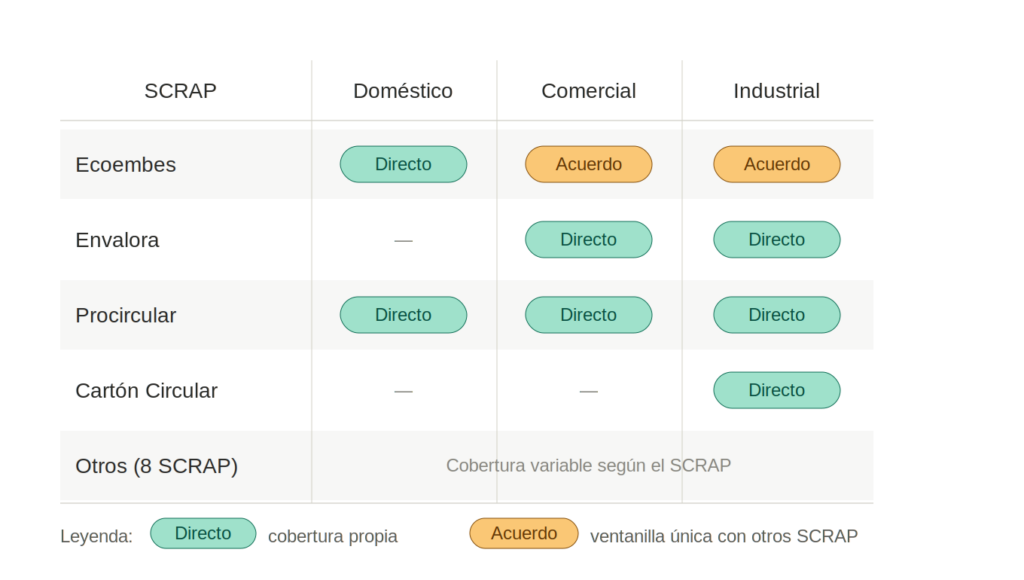
Comparative table of the main packaging SCRAPs in Spain by coverage: household, commercial and industrial. Source: Own research.
Choosing one SCRAP over another depends on several factors:
- The type of packaging you place on the market: household, commercial or industrial.
- Fees based on material and volume, including eco-modulation incentives (fee adjustments based on packaging sustainability, rewarding more recyclable packaging and penalising more complex formats).
- Logistics coverage and authorised waste managers in your area.
- Experience in your specific sector or with particular materials.
- Support and advisory services included in the fee.
Our recommendation? Get quotes from more than one SCRAP before signing up.
Recycling is not the destination; it is the last resort
SCRAPs do what the regulations require: finance and organise recycling. And that is no small task. Managing material flows at industrial scale, coordinating waste managers, reporting to the authorities and ensuring traceability are all activities that these systems have professionalised.
But recycling is the floor of the circular economy, not the ceiling.
The waste hierarchy establishes a priority order that European legislation (and recircular) has been advocating for years: first reduce, then reuse, and only when there is no alternative, recycle.
Recycling is the third option, not the first. And yet, under the current EPR framework, it is almost the only level that is structurally incentivised.
This is not a criticism of SCRAPs. It is a limitation of the regulatory design. Their mandate is recycling, and that is therefore where they focus their activity.
Source prevention, packaging reuse and industrial symbiosis fall outside this mechanism. There are no binding targets for these higher levels of the hierarchy, no indicators to measure them and no funding mechanisms that make them attractive.
This is where there is real room to go beyond what EPR requires.
What the annual declaration does not solve, recircular connects
Complying with EPR ensures that your packaging waste has a legal and traceable end-of-life pathway. What it does not guarantee is that this pathway is the most efficient or circular one.
Some material streams fall through the cracks of the conventional system: contaminated plastics, complex films, sorting rejects, production surpluses and other materials that are technically waste but still retain real value.
In the annual declaration, they are recorded as having been managed. In practice, many end up in landfill or energy recovery, the last step before disposal.
At recircular, we look for ways to make the most of the opportunities this space creates.
Through our platform, we connect companies generating these waste streams, surpluses or by-products with other businesses that can give them a real use in another industrial process.
It does not replace or compete with the SCRAP system. Instead, it operates at the higher levels of the waste hierarchy that the current regulatory framework does not yet fully cover: reuse and industrial symbiosis.
The result is twofold. On the one hand, materials that would otherwise move down the hierarchy find a higher-value outlet. On the other hand, companies can document this flow and quantify the savings in emissions and raw materials, strengthening any environmental reporting strategy beyond the minimum requirements.
Joining the appropriate SCRAP is the mandatory starting point.
What goes beyond recycling depends on how far each company wants to go.
If you would like to explore the operational details (deadlines, types of declarations, or prevention and eco-design plans) as well as the new EPR rules for industrial and commercial packaging, this webinar from January 2026 may be helpful.
