A just ecological transition starts with more women becoming entrepreneurs and closing the gap
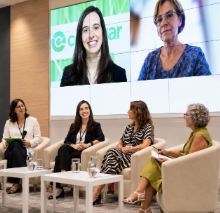
The MITECO event, with the participation of recircular, held in July 2025, provided an opportunity to highlight the role of women in the ecological transition.
The event served to present the report “Women in the Ecological Transition 2025,” a biennial publication that analyzes, from a gender perspective, the progress and challenges in areas such as green jobs, technical training, and the circular economy. Among the keynote speakers was Patricia Astrain, CEO of recircular, who shared her experience as a female entrepreneur and advocate for business models with social and environmental impact.
At a time when only 11.5% of green business activities have been undertaken by women, initiatives like recircular are even more valuable. As Minister Sara Aagesen reminded attendees at the event's opening, the green agenda “will only be fair and inclusive if it incorporates a gender perspective.”
Green Entrepreneurship and Women: Two Key Drivers of the Ecological Transition
The ecological transition presents a global environmental and social challenge, as it requires reducing inequalities and ensuring a just transformation.
Integrating a gender perspective into this process is therefore not only a matter of equity but also of effectiveness, especially considering that women tend to adopt more sustainable habits and show greater concern about climate change.
However, this contribution does not always translate into representation or leadership within the business world.
In this context, female green entrepreneurship is emerging as a driver of change. A good example is recircular, whose model, geared towards achieving a triple bottom line (environmental, social, and economic impact), allows us to better understand how women can drive a more inclusive and sustainable transition.
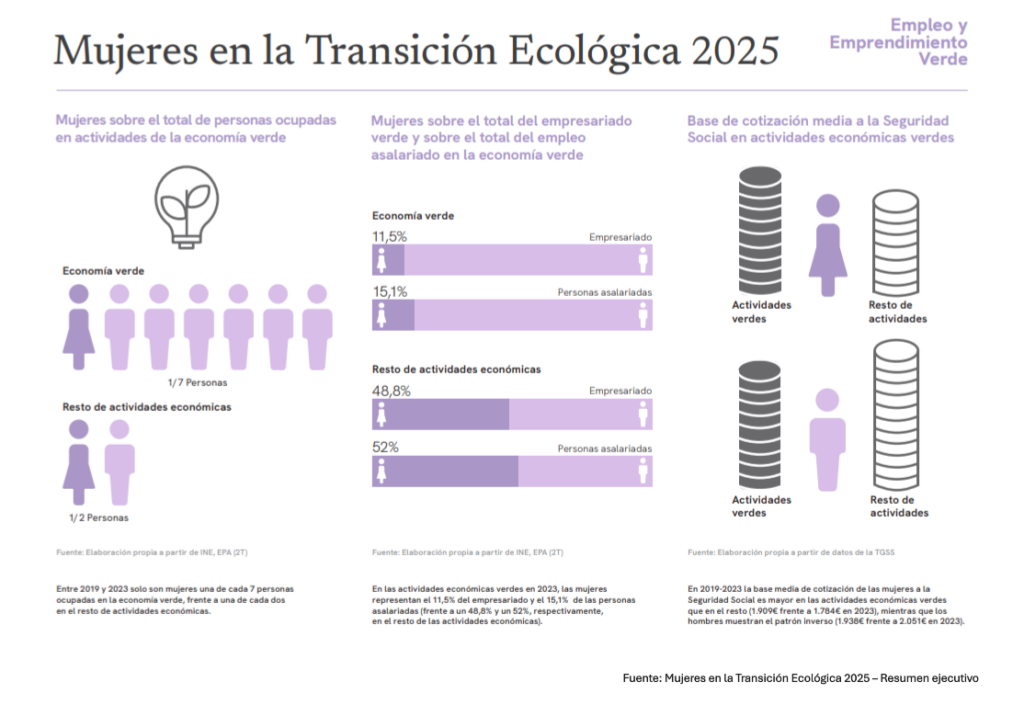
MITECO's event with participation from recircular and the presentation of the Women in the Ecological Transition 2025 report
Last July, the Ministry for Ecological Transition and the Demographic Challenge (MITECO) held an event to present the first Women in the Ecological Transition 2025 report.
This biennial publication incorporates a system of 58 indicators to assess the situation and progress of women in the ecological transition. Of these, 53 are analyzed quantitatively, with an intersectional gender approach, covering areas such as climate change, green jobs, governance, biodiversity, water, and the circular economy.
The document is based on a clear premise: the ecological transition will only be just and inclusive if it incorporates a gender perspective. At the opening of the event, Minister Sara Aagesen emphasized that this report seeks to "integrate and strengthen the gender dimension in this green agenda" and underscored the role of women as "agents of change" in the face of the environmental crisis.
The report includes a section on leading women in the circular economy, highlighting their experiences and challenges. This chapter also features the experience of Patricia Astrain, CEO of Recircular.

The Role of Women in the Circular Economy
If starting a business is inherently complex, women face additional obstacles, as Patricia Astrain emphasizes in the report.
- Private Investment: Projects led by women attract less private funding, and evaluation processes also exhibit biases reflected even in the types of questions asked.
- Public Investment: The circular economy needs more support, regardless of whether projects are led by men or women. This support must extend beyond a circular strategy. In the specific case of recircular, the awarding of a Circular Economy PERTE grant has provided substantial support, but it is necessary to create mechanisms that also promote other forms of financing throughout the life of the projects.
- Lack of Long-Term Support: Initial funding is plentiful, but monitoring and scaling mechanisms are lacking. Many initiatives fail because the circular economy needs more time to reach its full potential.
- Measuring the Environmental and Social Impact of Projects: Demonstrating environmental and social results is key. recircular uses its own Impact Measurement Methodology, although the social aspect remains a challenge due to a lack of comparable data.
These three fronts – financing, support, and measurement – make the difference between projects that barely get off the ground and solutions that transform sectors.
To advance the ecological transition, all voices are needed.
The Women in the Ecological Transition 2025 report shows that gender equality is an essential condition for the ecological transition to reach everyone.
Women's participation in green entrepreneurship and the circular economy also brings diverse perspectives and creative solutions, better able to address current challenges.
In this sense, Patricia Astrain's story and the Recircular experience confirm that it is possible to promote projects with environmental, social, and economic impact. But they also highlight the obstacles that remain and the need for a collective commitment to overcome them.
Creating the conditions for more women to become entrepreneurs, giving visibility to their achievements, and consolidating transformative initiatives are key to progress.
A just and inclusive ecological transition requires the participation of everyone, and experiences like Recircular show that this path is not only possible, but also the one that opens the door to a more sustainable future.
