Industrial Symbiosis in Industrial Parks: Opportunities to Share Resources and Waste
On paper, industrial symbiosis in industrial parks is one of the most powerful ways to put the circular economy into practice.
Yet its implementation remains limited, not so much because of a lack of potential, but because of a lack of connection between companies that have surplus materials, by-products or underused machinery in storage and businesses that could put them to use.
38% of companies are already practising industrial symbiosis without knowing it
Interestingly, this lack of connection between supply and demand does not prevent companies from exchanging waste among themselves, as shown by a survey conducted by the Valencian Community Industrial Symbiosis Observatory among 389 industrial companies.
The term “industrial symbiosis” was largely unknown among the businesses surveyed. However, when the study focused on their day-to-day operations, the results showed that 38% had already exchanged waste or resources with other companies.
In other words, industrial symbiosis in industrial parks already exists, at least in an embryonic form, because companies share surplus materials and by-products. But the tools to systematise and scale these exchanges are still missing.

Why business-to-business waste exchanges have not yet taken off
The same study also identified a number of barriers, including bureaucratic hurdles, lack of training and uncertainty about the return on investment.
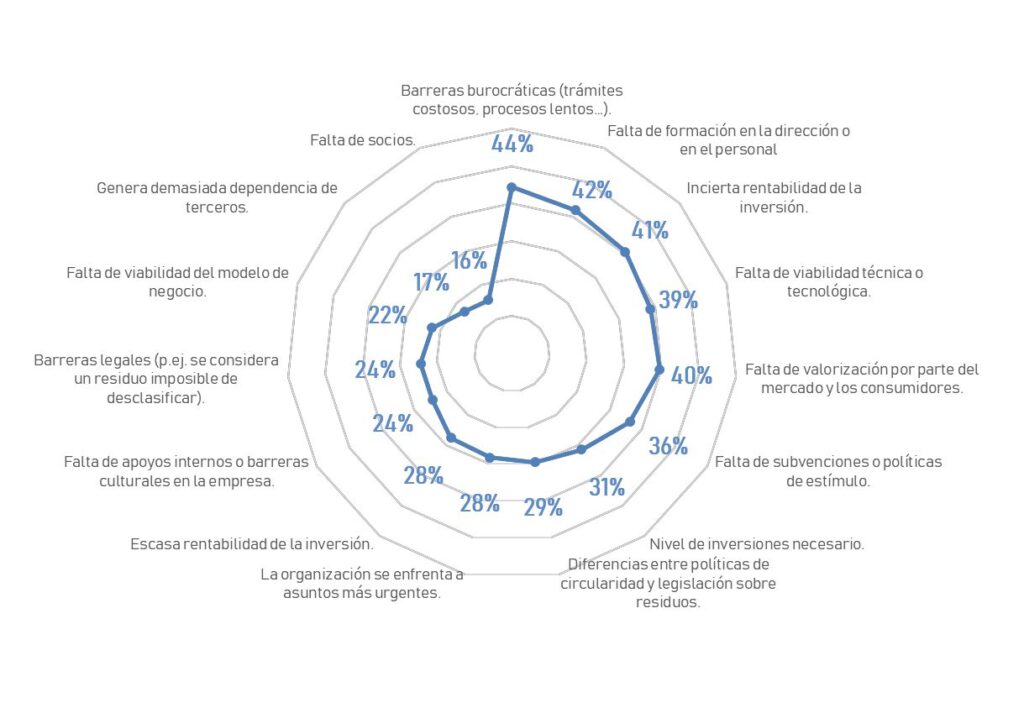
Source: Valencian Community Industrial Symbiosis Observatory.
These obstacles help explain why some industrial symbiosis initiatives fail to progress beyond pilot projects.
Initiatives such as the European Circular Challenge project are working to overcome these barriers in industrial parks in Castilla y León and Portugal by combining training activities with the creation of industrial symbiosis ecosystems.
What makes industrial symbiosis in industrial parks actually work
Industrial symbiosis, as we discussed in another article, offers numerous tangible benefits:
- savings on material purchases;
- lower waste management costs;
- a reduction in the volume of waste generated;
- reduced extraction of natural resources; and
- stronger positioning in the green transition.
The ILO, for example, has documented how these networks generate both direct and indirect employment, both within participating companies and across waste logistics, treatment and recovery activities. These findings come from studies in Latin America, but we understand that the underlying mechanisms can be extrapolated to other geographical contexts.
However, the key to making these initiatives successful is having someone responsible for turning potential synergies into actual exchanges.
The programme run by FEPEVAL and the Provincial Council of Alicante demonstrated this in 2024 through a methodology applied across 14 industrial areas and more than 100 participating companies, which identified 459 potential synergies. Putting them into practice would result in €7 million in annual savings and prevent 100,000 tonnes of waste from ending up in landfill.
Identifying synergies, however, is one thing; putting them into practice is another. The CORALIS project, funded by the Horizon 2020 programme and coordinated in Spain by the CIRCE Foundation, took this a step further in Basauri, demonstrating that waste heat recovery in the steel industry is viable when an agent or facilitator supports the process from design through to implementation.
recircular's role in industrial symbiosis
At recircular, we act as that much-needed facilitator. We are currently involved in two initiatives:
- Villalonquéjar Industrial Park, in Burgos, active since May 2024, where companies are already carrying out transactions involving waste, by-products, surplus materials and machinery through our platform; and
- Sant Lluís Business Park, in Menorca, where the dynamics differ from the Burgos case because, on an island, exporting waste and importing raw materials comes with additional costs.
The weight of tourism is also relevant in the Menorca case. A 2020 article in the journal Economía Industrial had already highlighted the potential of industrial symbiosis in tourism destinations, identifying recircular as one of the platforms capable of facilitating the process.
The model is similar in both cases: free access to the platform for companies within the industrial park, support throughout the registration process, identification of synergies and generation of impact reports.
A replicable model for industrial parks ready to take the next step
The question is not whether there is potential to exchange waste and resources. As you have seen, companies are already doing it on their own initiative.
The real question is who will drive the process and prevent these opportunities from being left on the shelf.
If you manage an industrial park or are part of its business community, you can find out how we work with these business areas.
