How to increase the positive environmental impact of company purchases

For years, purchasing departments have been evaluating suppliers based on price, delivery times and quality, three variables that occupy three columns in an Excel spreadsheet and which, for many companies, have been sufficient for making decisions.
But something is changing. More and more businesses are discovering that generating a positive environmental impact does not depend solely on what they manufacture or how they manage their facilities. Above all, it depends on what they buy.
They can install solar panels, reduce water consumption in their plants and rigorously separate waste. And yet, most of their carbon footprint still comes in through the back door, camouflaged in every order for materials, every service contract, every supplier that no one has evaluated beyond price.
Purchasing is the blind spot of many environmental strategies. It is also where the circular economy ceases to be theory and begins to translate into concrete decisions such as choosing recovered materials, reconditioned equipment or industrial surpluses that already exist instead of manufacturing from scratch.
Purchasing with a positive environmental impact: from intuition to method
The UNE-ISO 20400 standard defines sustainable procurement as purchasing that seeks to achieve the greatest positive environmental, social and economic impact throughout the entire life cycle of the product or service.
It is not about buying “green” for image reasons. It is about integrating ESG (environmental, social and governance) criteria into every procurement decision.
Order TED/1211/2022, which regulates aid for promoting the circular economy within the framework of the PERTE, already highlights the importance of integrating sustainability criteria into corporate procurement. And Directive (EU) 2024/1760 on sustainability due diligence already requires this: large companies must apply due diligence throughout their entire chain of activities, including their supply chain, and may be held civilly liable if they fail to comply with these obligations and damage to human rights or the environment occurs.

What you gain when your purchases leave a positive footprint
Generating a positive environmental impact through your company's purchases is synonymous with risk management, efficiency and positioning.
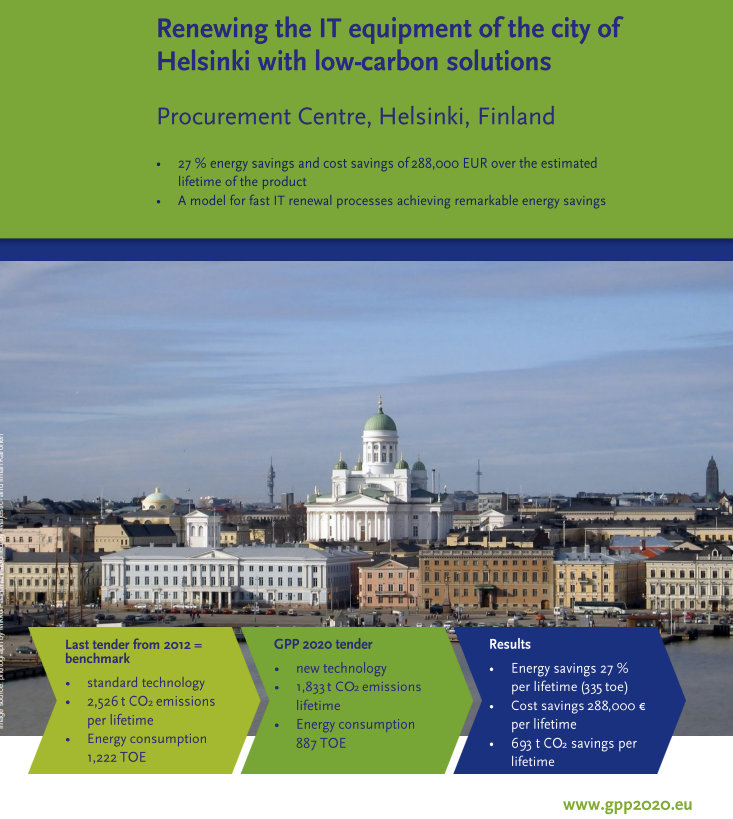
The city of Helsinki required efficient IT equipment in its tenders and achieved a 27% reduction in CO₂ emissions. When moving offices, Public Health Wales prioritised the reuse of existing furniture, avoiding 41 tonnes of waste and 134 tonnes of CO₂, according to data from the European Procura+ programme.
These are not exceptions. They are signs of a change that is also affecting the private sector. Acer, for example, applies an ESG scorecard to its suppliers: in 2024, 71% obtained an ‘excellent’ rating.
Why do they do this? Because they have understood that responsible purchasing not only reduces impact. It also
- generates value;
- reduces reputational risk;
- decrease exposure to supply issues, and
- improve access to ESG-linked financing.
Circular procurement, the next step
This is where the circular economy comes in. And where many companies fall short.
Applying sustainability criteria is fine. But if you only require certifications from your suppliers and continue to buy new products, the real impact is limited.
Circular procurement goes one step further: it prioritises reused materials, reconditioned equipment and industrial surplus that other companies no longer need.
This is not an abstract concept. It is a practice that already works.
At recircular, we connect companies that have waste, materials, equipment or underused by-products with others that can put them to good use. What was once a waste management cost becomes a resource with economic and environmental value.
Where can you start? By reviewing which purchases could be covered with second-life materials: tools, machinery, industrial packaging, secondary raw materials.
The price difference can be as high as 60%. And the reduction in carbon footprint, depending on the type of product, can be between 18% and 37%.
Buy better, not just buy less
A positive environmental impact is not achieved solely by reducing consumption. It is also achieved by making better choices.
And that starts in the purchasing department, reviewing suppliers, including environmental criteria in evaluations, and exploring strategies linked to the circular economy.
There is no need to overhaul the entire procurement policy at once. Just start with one category, measure results, and scale up.
At recircular, we can help you identify these opportunities.
Because every purchase is a decision. And every decision is an opportunity to generate a positive environmental impact.
