Hidden costs in waste management in companies: economic and environmental impact
In most companies, waste management appears in the budget as just another line item. A fixed figure that is renewed periodically, negotiated with the waste management company and forgotten until the next quarter or year.
But that line item hides more than meets the eye: a series of hidden costs in waste management that go beyond a simple invoice.
This variable, resulting from poor waste management, is hidden in the materials that are thrown away without knowing that they have value, in the space occupied by surplus that no one has reviewed, or in sales opportunities that are lost due to a lack of information.
According to an analysis by Teimas, waste management can account for around 5% of a company's turnover, reaching 10% in some cases. And much of that expenditure is not visible

Where the hidden costs lie
The problem starts with how it is accounted for. Waste is often treated as an aggregate item, without being broken down by flow or business unit. This makes it impossible to know how much of the expenditure is avoidable.
To accurately determine the cost of waste management, you first need to measure material flows: what materials enter the process or plant, what is lost along the way, what is stored, what each material is worth, etc. Measurement is essential for improvement, including in waste management.
The hidden costs of waste management are spread in several directions:
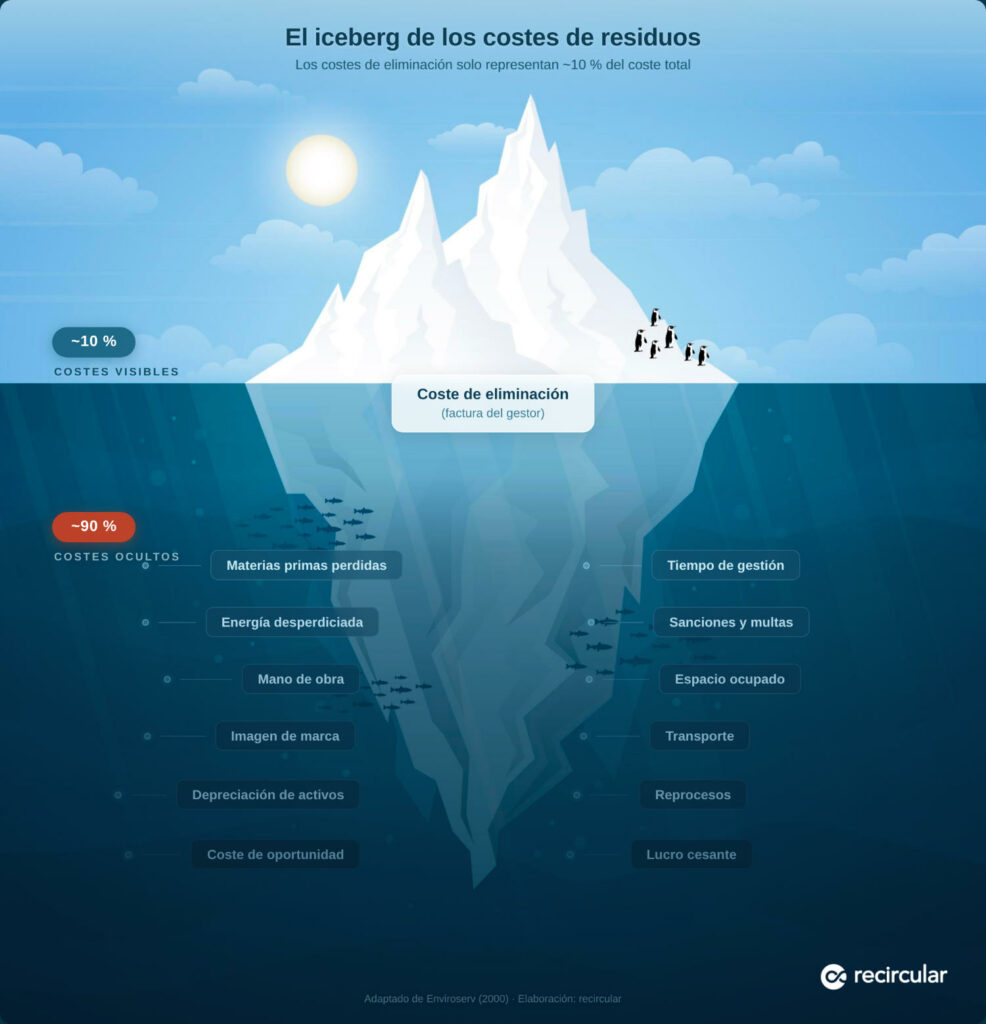
- Raw materials that end up in the bin, one of the most obvious and least accounted for. Each discarded material carries with it its purchase cost and the energy, water and other resources used to process it. When a company does not measure product losses online, it is paying twice: once to purchase the material and again to manage it as waste. In the food sector, for example, waste reduction programmes can generate returns of 14:1 for every unit invested, which gives an idea of the margin lost by not taking action.
- The space occupied by these materials could be replaced by production lines or useful storage.
- The obligations imposed by legislation, because Law 7/2022 on waste and contaminated soil, as we mentioned in our blog, imposes direct obligations on companies, ranging from the separation of waste at source to the maintenance of complete traceability records through the Electronic Waste Information System (eSIR).
The opportunity cost that no one calculates
And, of course, there is what is lost by not acting, because much waste is not waste. It is by-products, underutilised machinery, obsolete spare parts, materials that were purchased at some point and never used, etc., with a market value that no one has calculated.
Industrial symbiosis networks, for example, generate billions of dollars annually from companies that connect their surpluses with the needs of others and convert disposal costs into revenue by reducing the hidden costs of waste management.
Failure to map waste, therefore, leaves the company out of that market. And in a context where metals such as copper occasionally reach or exceed €10,000 per tonne, not knowing what materials are in your warehouse is equivalent to storing cash that depreciates due to lack of classification.
That is why the first step is not to change managers or install more containers, but to carry out an industrial inventory that accounts for what is generated, in what quantities and at what cost.
Without that picture, any decision is made blindly.
How to identify and quantify the hidden costs of waste management in my company
The path to identifying and reducing hidden costs in waste management involves three specific actions:
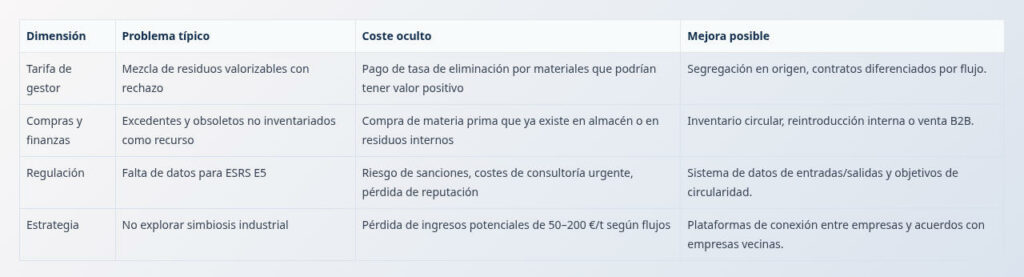
- Link operational and financial data, associating each waste stream with accounting accounts: purchases, depreciation, fees and revenue from recovery. Only then can you distinguish between what it costs to dispose of and what could generate value.
- Digitise traceability, recording inputs, outputs, destinations and costs by flow and supplier. Without this detail, data is aggregated and decisions are generic.
- Seek circular connections, identifying which waste generated by one company can be used as raw material by another. This is where recircular acts as an intermediary, matching surpluses, by-products and underutilised equipment from some companies with the needs of others, quantifying savings and proposing connections that would be difficult to find through conventional channels.
Not all waste can be turned into gold, but there are many cases where the difference between paying to get rid of something and charging to sell it can move the needle on the bottom line.resultados.
From fixed cost to profitability lever
The hidden costs of waste management do not disappear on their own. They are uncovered when someone sits down to look at the numbers in detail and asks an uncomfortable question: how much money are we throwing away with the rubbish?
At Recircular, we help answer that question with a flow diagnosis, identification of recovery opportunities and access to a network where one company's waste can be another company's treasure.
Good waste management is not just an environmental issue.
It is a financial decision that many companies have not yet made.
