The Future of Sustainable Construction and Furniture Is Built with Engineered Wood
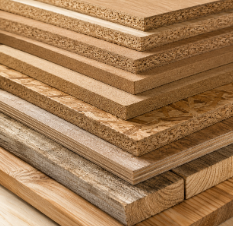
Human history is intrinsically linked to wood, from the earliest tools to today's most modern skyscrapers.
Growing demand, however, is leading to the overexploitation of forests, key ecosystems that act as carbon sinks. In this context, engineered wood offers a solution to our need to keep building without destroying the environment. By transforming by-products such as sawdust, wood shavings and forestry waste into strong and versatile materials, it reduces the need to cut down trees and promotes the circular economy.
But how is it made and what advantages does it offer? Keep reading, because we're going to show you why engineered wood is a key material in the transition towards a more sustainable world.
What Is Engineered Wood and How Is It Made?
Engineered wood, also known as composite wood or engineered timber, is an innovative material that is redefining the use of wood in construction and design.
Unlike natural solid wood, it is manufactured industrially by combining layers, fibres or forestry by-products such as sawdust, wood shavings, wood chips or small logs with adhesives, under high pressure and temperature. Think of it as a kind of wood sandwich.
Its main strength lies in turning waste into valuable resources, in line with the principles of the circular economy.

How Engineered Wood Transforms By-products into Sustainable Materials
Engineered wood turns by-products into valuable resources.
The process may vary slightly depending on the final product being manufactured. However, in general terms, the manufacturing process follows these steps:
- Selection and collection of the raw material, including by-products from sawmills (sawdust, wood shavings, etc.), post-consumer wood (transport pallets, discarded furniture, etc.) and forestry waste (branches, offcuts, etc.). Our valorisation platform is a good place to find this type of material.
- Shredding the wood to obtain smaller and more uniform particles, ensuring consistency and strength in the final product.
- Mixing with adhesives and other plant-based components, such as lignin and cellulose.
- Pressing and forming the mixture using heat and pressure.
- Cutting and finishing according to specific requirements.

Source: Engineered wood made from LSL wood shavings. Infomadera, 2012
How to Choose the Right Type of Engineered Wood for Each Application
There is a wide variety of engineered wood products available on the market.
Some products, such as particleboard, are already well known. But you can also find fibreboard, plywood and Oriented Strand Board (OSB), which is manufactured from wood strands, among others.

Source: Engineered wood profiles. Construcción Sostenible con Madera
The applications of this recovered wood material are diverse and include furniture, wall coverings, flooring and even buildings. One example of its structural potential is Mjøstårnet in Norway, the world's tallest timber building at 85.4 metres, whose construction used glulam.
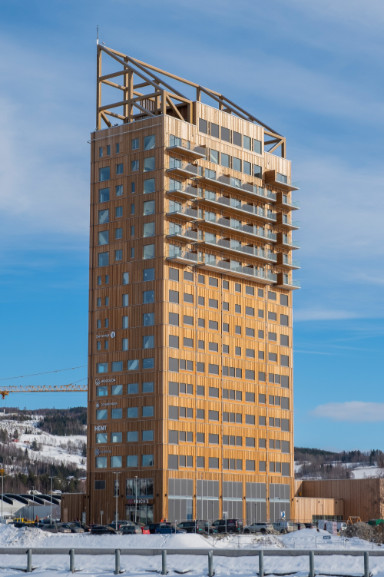
Source: Wikipedia, 2024
A Key Solution for Reducing Waste and Protecting Forests
Engineered wood fits perfectly with the principles of the circular economy.
But it also offers other structural, environmental and economic advantages:
- Reduces deforestation, helping forests continue to perform their role as carbon sinks.
- Helps reduce carbon emissions, with studies pointing to reductions of between 51% and 77%.
- Makes furniture manufacturing more affordable, making products more accessible. IKEA, for example, uses particleboard in its designs.
- Drives innovation and research, serving as the basis for European projects such as Wood2Wood, InFutUReWood and RECOWERS.
Where Is the Future Heading?
The shift towards new, more sustainable and efficient manufacturing methods is clear.
For example, there have been advances in bio-based adhesives, as well as the use of NIR sensors to obtain high-quality raw materials.
Public authorities are also encouraging circular practices and strategies for recovering construction waste. The Waste Framework Directive, for example, establishes a target of 70% for the reuse, recycling and recovery of construction and demolition materials, including wood, encouraging investment in sorting technologies.
The Future of Sustainability Lies in Engineered Wood
Engineered wood is a sustainable, efficient and versatile alternative for construction and furniture manufacturing.
Its ability to reduce environmental impact, improve resource efficiency and offer enhanced structural properties makes it a key material in the transition towards a more circular production model.
Are we looking at one of the materials of the future?
