Regulatory Trends in Circular Economy and Waste Management in Spain

2026 is a turning point for circular economy regulatory trends in Spain.
Rules that have been in the making for years, both at European level and within Spanish institutions, are now becoming enforceable, with specific deadlines, mandatory reporting and real penalties.
And for many companies, the window to prepare is closing fast.
The circular economy regulatory obligations and trends that will have the biggest impact on your business in 2026
Five areas account for most of the regulatory pressure this year.
Some requirements are already in force, while others are rapidly approaching their implementation dates.
All of them require action, not just monitoring.
Packaging: August as the key deadline
The most immediate milestone is Regulation (EU) 2025/40 on packaging and packaging waste (PPWR), applicable from August 12, 2026 across all EU Member States.
It replaces the previous Packaging Directive and, unlike a directive, is directly applicable in all countries, leaving less room for national interpretation.
What does this mean in practice? Packaging must meet three conditions:
- Be recyclable by design and carry harmonised labelling providing information on its composition and disposal route.
- Meet new minimum recycled content requirements.
- Ensure reusability for certain single-use industrial and commercial packaging formats.
The European Commission published a technical guidance document in March to facilitate implementation.
At the same time, Spain is working to adapt its national framework. Royal Decree 1055/2022 remains the reference legislation for reporting, producer registration and SCRAP schemes, but it is currently being reviewed to align it with the European regulation. Until that update is completed, the PPWR takes precedence in the event of a conflict.

Ecodesign and the Digital Product Passport
The Ecodesign for Sustainable Products Regulation (ESPR) introduces the Digital Product Passport (DPP), a standardised set of digital information linked to each product unit, containing verifiable data on materials, environmental footprint, reparability and recyclability.
2026 is the year in which the infrastructure begins to take shape, with the European identifier registry and technical standards needed to support compliance.
The first general DPP requirement will take effect for batteries in February 2027, although some electronics segments are already preparing for it. Most product categories are not yet required to have a DPP in 2026, so starting now to organise and structure your product data will give you a clear advantage when mandatory deadlines arrive.
The timeline in the ESPR 2025–2030 Working Plan is the most practical reference for understanding which product categories apply to each company.
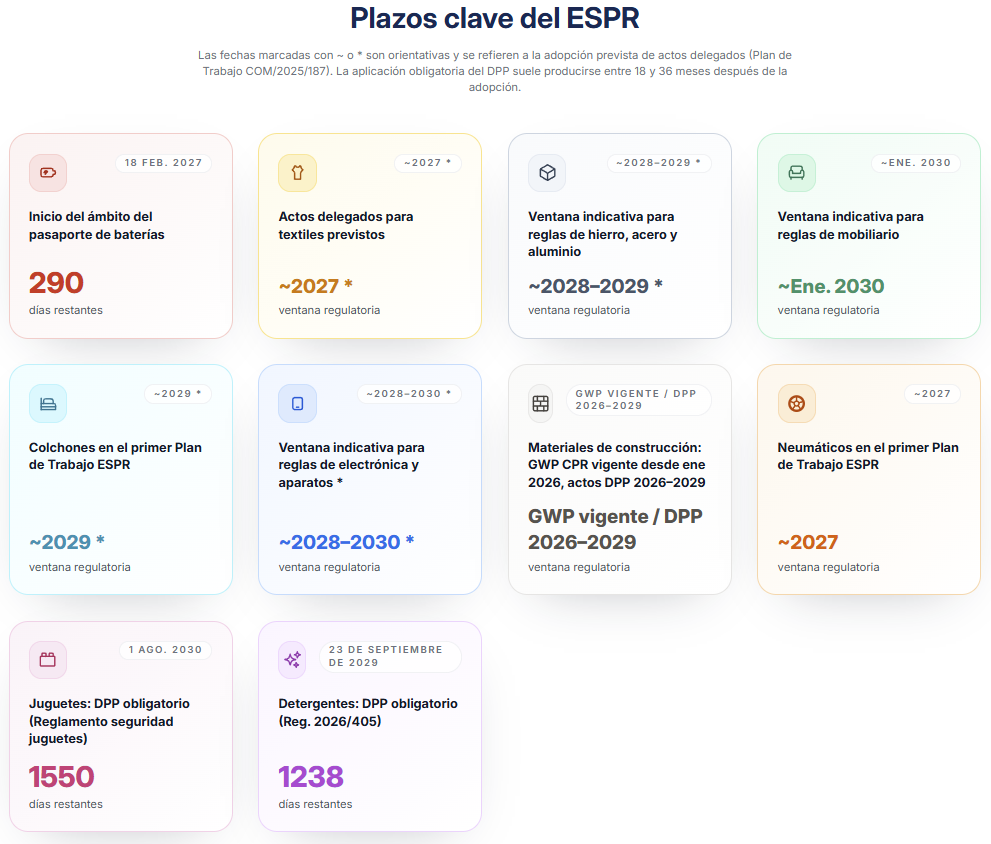
Source: InfoDPP
Extended Producer Responsibility
EPR/SCRAP schemes are now entering full operational implementation.
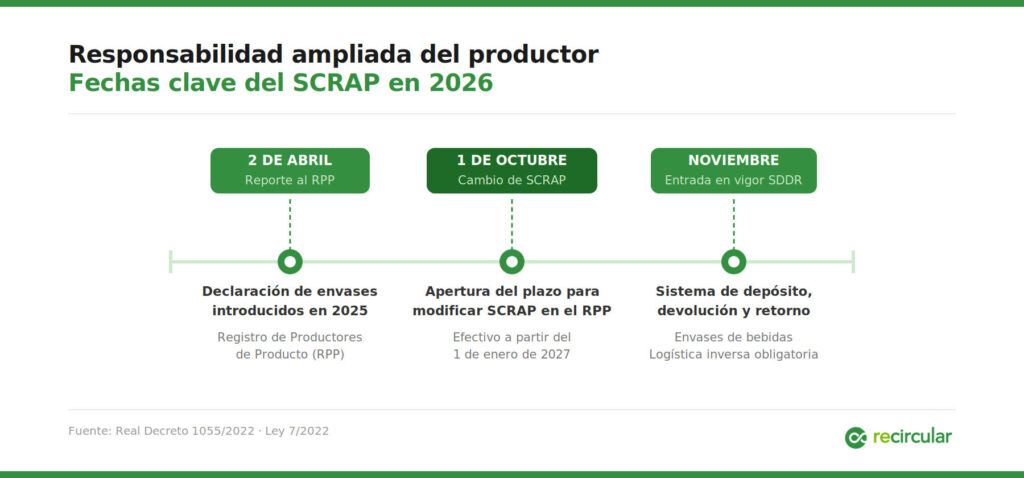
Royal Decree 1055/2022 requires producers of industrial and commercial packaging to report the packaging they placed on the market to the Product Producers Register (RPP) for the previous reporting year, with the deadline extended this year to April 2.
In November 2026, the Deposit Return System (DRS) for beverage packaging will also come into force, with all the implications this has for reverse logistics and traceability.
And from October 1, companies will be able to switch SCRAP schemes for 2027.
Implementation, however, continues to face real challenges due to a lack of coordination between administrations.
Food waste
Law 1/2025 on the prevention of food loss and waste has been applicable since April 2026.
What was previously a CSR practice is now a legal obligation with a hierarchy of uses: first prevent, then donate, and finally recover.
Retail, hospitality and mass-market food businesses are the sectors most exposed, but the legislation also has implications for your company if you generate food surpluses at any point in the supply chain.
Refilling and reuse
While still more of a future trend, packaging refill and reuse requirements are gaining increasing legal relevance, particularly within the European Union, with the aim of promoting the circular economy and reducing waste.
The new EU Regulation 2025/40 strengthens these measures with specific targets, complementing national legislation such as Royal Decree 1055/2022 in Spain.
The HORECA sector has refill targets for takeaway food and beverage packaging from February 2027 and reuse targets from February 2028.
How recircular helps you comply with circular economy regulations
The circular economy regulatory trends shaping 2026 have one thing in common: the growing requirement to demonstrate what you do with your materials using reliable data.
This means documenting processes in a verifiable and traceable way.
That is exactly what recircular helps you manage. Through our platform, we connect surplus materials, by-products and waste with companies that can put them to use, while providing digital traceability for every transaction.
In 2026, something that was once an added value is becoming an operational necessity.
And if you need help implementing other circular economy strategies and meeting your regulatory obligations, take a look at our other services.
