Circular economy in 2025: progress, obstacles and a long way to go
The circular economy in 2025 promised a little more.
It has had its bright spots, materialised in new regulatory frameworks in Europe and the first global measurement protocol. But there have also been shadows, with frozen regulations, treaties that did not come to fruition and indicators that are not improving at the necessary pace.
In this regard, the figure that perhaps best sums up the year is this: the percentage of secondary materials entering the market stands at 6.9%, down from 7.2% in 2018 (Circularity Gap Report 2025).
This percentage essentially means that we continue to extract more resources than we reintroduce into the production cycle.
But it also means that there is enormous room for improvement. And the tools to make this a reality already exist.
The bright spots of the circular economy in 2025
The year began on a positive note.
In February, Regulation (EU) 2025/40 on packaging and packaging waste (PPWR) came into force, repealing Directive 94/62/EC and establishing a framework directly applicable in all Member States. Its main obligations will begin to apply from August 2026, after a transitional period of 18 months.
The PPWR harmonises requirements and objectives at EU level in terms of packaging design, recyclability, recycled content and, in part, reuse, reducing differences between national laws, although Member States retain some leeway in their practical implementation, controls and penalty system.
COP30 in Belém included for the first time a specific day on the circular economy, bringing it into the climate conversation with a prominence never before achieved.
The Global Circularity Protocol was also launched, promoted by the World Business Council for Sustainable Development with companies such as Apple, IKEA and Toyota.
It is a new global standard for measuring business circularity. Voluntary, yes, but it offers a common language that did not exist until now.
By 2025, Spain will have made significant progress in the circular economy, with a circular material use rate of 8.5%, exceeding the global average but below the EU average of 11.8%.
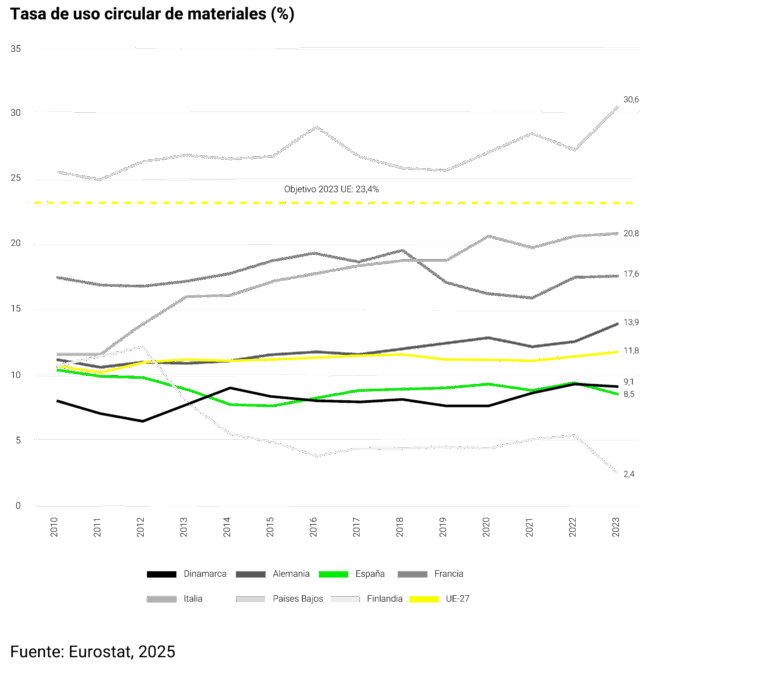
According to the Cotec Foundation, the Spanish economy ‘now produces more wealth using fewer materials than it did ten years ago’.
The reason for this can be found in resource productivity, which rose to €3.53 per kilo of material in 2024 (compared to €2.99/kg in the EU). This data means that the economy is growing with less environmental impact, alongside the leadership of regions such as Madrid and Catalonia.

The shadows of the circular economy in 2025
Among the black spots left by 2025 in terms of circularity, we highlight the suspension in June of the Green Claims Directive, which was going to regulate companies' environmental claims and, in terms of the circular economy, sought to promote ‘sustainability throughout the life cycle of products, from production to final disposal’.
Another setback in 2025 came from Geneva, with the closure without agreement of the Global Plastics Treaty after three years of negotiations. The lack of consensus on production limits left the agreement up in the air. It remains an unresolved issue for international governance.
At the national level, the shadows also weigh heavily: Spain ends the year below its targets.
The actual recycling rate is estimated at around 41-43% (41.2% in 2022), well below the 55% required by Europe for 2025, and even below the 60% required for selective collection.
Furthermore, the SDDR, the deposit and return system, has been postponed until 2029.
The opportunity is still there
These shadows do not negate the progress made.
The PPWR is in force and companies have to adapt. The Global Circularity Protocol offers a methodology that could become the market standard. European funding for circular projects remains active.
And there is something that does not depend on regulation: every company can decide today how it manages its materials, its surpluses and its equipment. Extending the useful life of an asset, selling off idle stock, replacing virgin material with secondary material. These are decisions that generate economic and environmental value without waiting for anyone to legislate.
At recircular, we are no strangers to the uncertainty felt by companies in the face of the international geopolitical situation, the lack of decision-making on real progress and the reversal of some regulations. The interest in the circular economy that existed a few years ago seems to have slowed down in many companies, reducing it to isolated initiatives without this meaning that substantial changes are being made.
However, we remain committed to it because the opportunity is real: sustainability, organisational resilience, economic savings and anticipation of regulations that will come sooner or later.
In addition, we see positive trends, such as the fact that reuse in industrial environments works. The vast majority of sales on our platform are for reuse, confirming this trend for the second consecutive year. We have also opened up new lines of collaboration with local councils, business associations and industrial estates, expanding the areas where circularity has a future.
What to look for in 2026
Next year will bring the effective implementation of the PPWR, the possible proposal for a European Circular Economy Act and more pressure on Member States to demonstrate results..
We will also see whether the Global Circularity Protocol gains traction among medium-sized companies, not just large ones.
The signs to watch out for are specific:
- More repair and longer useful life.
- Less recycling as the sole metric.
- Real reduction in virgin materials, not just percentages.
- Secondary material markets with stable demand.
At recircular, we will reinforce the territorial lines of work we have opened this year, exploring collaboration models that reduce waste at the local level and generate value for participating companies. We will continue to promote industrial reuse and the development of secondary markets, helping to transform strategies into concrete actions.
Because the circular economy only advances when it is implemented.
