II Circular Economy Action Plan: new opportunities for waste recovery
The II Circular Economy Action Plan (II PAEC), approved by the Spanish Council of Ministers on January 27, 2026, turns into national policy what until now had largely been driven by initiatives from organisations such as recircular that were already moving towards a circular model.
And for those who still do not know where to start, the plan sets out a roadmap backed by funding, measures and institutional support.
What are Circular Economy Action Plans, and what changes with the second one?
The Spanish Circular Economy Strategy 2030 sets the long-term objectives.
To implement them, Law 7/2022 on waste and contaminated soils for a circular economy requires the Spanish Government to develop three-year action plans with concrete measures.
The first plan (2021–2023) laid the foundations for the framework, but without a quantified overall budget. The second marks a significant step up in scale: 105 measures, almost €1.885 billion in estimated investment, 12 ministries involved and more than 40 coordinating directorates and administrative units.
From a statement of intent to a plan with figures and clearly assigned responsibilities. That is what changes.
As Alejandro Dorado, Spain's Commissioner for the Circular Economy, explained during a February 2026 webinar organised by the Spanish Circular Economy Observatory (see attached video), the II PAEC's key added value is that it organises the action of the Spanish General State Administration by assigning clear responsibilities to the different administrative units, both for implementing and financing the measures.
What does the II Circular Economy Action Plan say about waste recovery?
The plan is structured around five key areas: production, consumption, waste management, secondary raw materials and water reuse.
These are complemented by three cross-cutting areas (innovation and research, participation and awareness, and employment and training), plus an additional set of measures covering governance, a just transition, demographic challenges and gender.
For a company generating industrial waste, or a public administration managing materials from its suppliers or infrastructure, the most relevant opportunities are concentrated in two of these areas:
- Waste management: the plan reinforces the hierarchy already established by Article 8 of Law 7/2022. Recycling does not disappear from the picture, but it is no longer the automatic first response:
- prevention;
- preparation for reuse;
- recycling;
- other forms of recovery, including energy recovery; and
- disposal.
- Secondary raw materials: the aim is to reduce dependence on non-renewable resources by returning materials contained in waste streams to the production cycle. This also strengthens Spain's industrial strategic autonomy in relation to third-country suppliers of virgin raw materials, one of the objectives identified as a priority by the EU. In other words, what leaves your process as waste may be the raw material someone else needs. This is something companies that have been practising industrial symbiosis for years already know, as do those planning industrial inventories to identify surplus materials and reduce waste.
Taken together, these areas outline the path that recircular has been following for years: less waste ending up where it shouldn't, more materials returning to the production cycle, and greater economic value generated along the way.

How has the sector responded? More cautious than enthusiastic
The overall response has been positive, but with some important caveats.
The plan itself acknowledges that it is not legally binding. Its measures guide the actions of the Administration, but they do not automatically guarantee implementation. In other words, the plan sets the direction, but it does not require anyone to reach the destination.
The clearest summary was published by Residuos Profesional in a recent analysis of the II PAEC: the debate is no longer about what needs to be done, but about how to make it technically and financially viable.
recircular: where the plan becomes operational
The gap between what the plan describes and what actually happens on a company's production floor or in its warehouse is precisely where recircular operates.
The platform connects companies with surplus materials, by-products or recoverable waste with other businesses that can put them to use, making operational the II PAEC's objective of keeping materials within the economy for as long as possible.
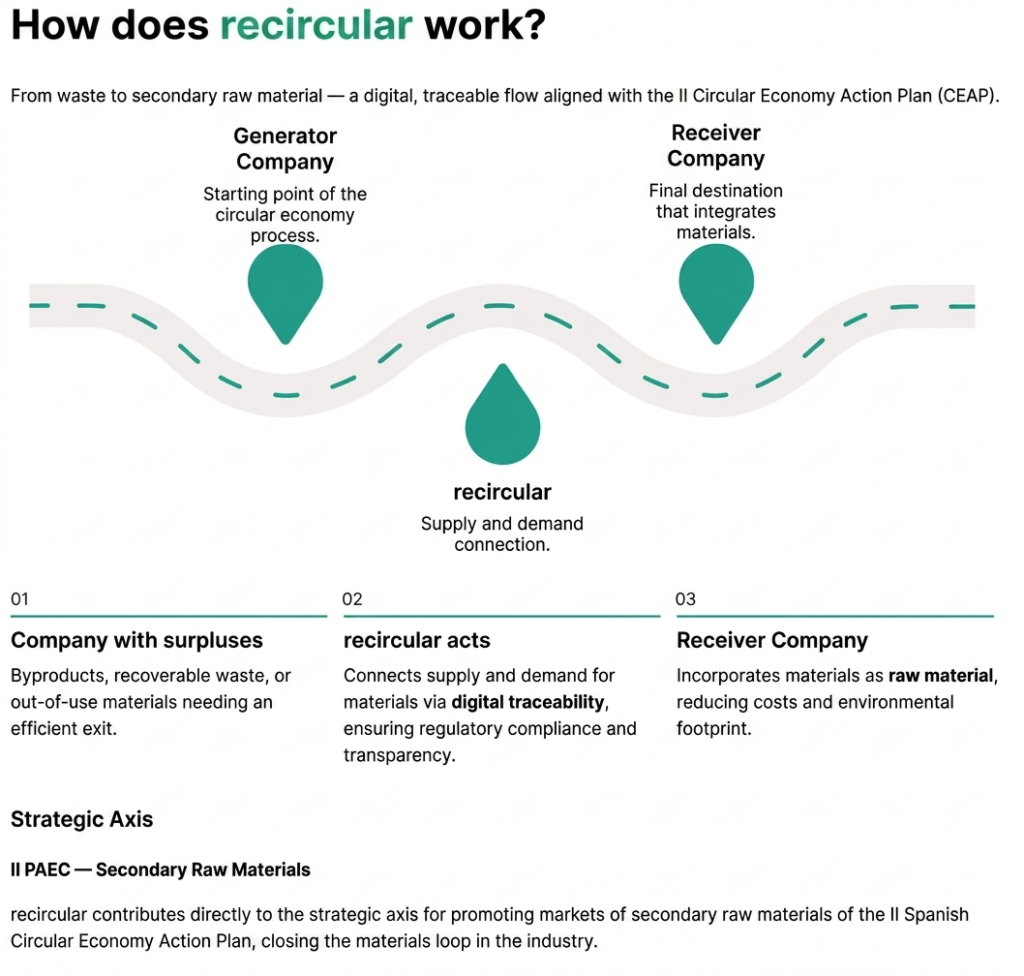
And it does so with digital traceability for every exchange, turning the digitalisation of waste management into something concrete and measurable rather than simply another line in a policy document.
There is no need to wait for the regulatory framework to be fully developed before taking action.
If you want to find out whether your waste streams or surplus materials could fit into this model, you can explore the platform or contact the team for an initial assessment.
