Advantages of purchasing second-hand materials and equipment

Buying second-hand materials and equipment is no longer a marginal option.
Until recently, when a company decided to renew its machinery, replenish raw materials or equip a new headquarters, the first option was always to buy new. Open the manufacturer's catalogue, request a quote, wait weeks or months and pay the agreed price.
However, purchasing used materials and equipment is a practice that is gradually gaining ground in the business world due to the advantages it offers from an operational, economic and environmental point of view.
At recircular, we are contributing to this change by connecting surplus, waste and underused equipment from some companies with the material needs of others. In this way, we convert what was previously a waste management cost into a resource with economic and environmental value.
What your company gains when it buys second-hand goods
When you buy second-hand materials and equipment, you not only adjust your capital expenditure or CAPEX. You also reduce your environmental impact, ease the strain on your cash flow and gain operational and strategic margin.
- Environmental: every piece of equipment whose life you extend means avoided emissions and conserved raw materials. Reusing electronic devices reduces the carbon footprint by between 18% and 37% compared to manufacturing new ones, according to Fraunhofer UMSICHT and Interzero (2025). The REMADE Manufacturing USA institute estimates that remanufacturing can eliminate between 80% and 98% of GHG emissions and the use of virgin materials, in line with what is already observed in the reuse of materials.
- Economic: reconditioned and second-hand equipment offers savings of 40% to 60% compared to new equipment, according to a McKinsey analysis. In heavy machinery, for example, Caterpillar offers remanufactured components with a 12-month warranty at prices ranging from 45% to 85% of the cost of new equipment.
- Operational: purchasing new equipment can involve months of waiting. Second-hand or reconditioned equipment, on the other hand, is usually available within days or weeks. In addition, specialist suppliers carry out inspections, replace wear parts and offer warranties comparable to those for new products, based on schemes such as BSI Kitemark.
- Strategic: for companies required to calculate and report their carbon footprint from June 2025 onwards in accordance with Royal Decree 214/2025 (scopes 1 and 2), purchasing second-hand materials and equipment generates reliable information for estimating reductions in scope 3 (acquired goods). Although the calculation of this scope is voluntary but recommended, it has become a clear argument for environmental and reputational positioning.

How to identify opportunities to sell or purchase second-hand materials and equipment
Every industry has warehouses full of spare parts and semi-new materials, used products (e.g., logistics and storage items such as boxes and pallets) and used equipment that the company no longer needs. All these fixed assets take up space and generate costs for the company, so selling them and generating income from them seems like an interesting strategy.
Identifying opportunities to buy second-hand materials and equipment or to sell your own starts with a thorough inventory. If you are not sure where to start, at recircular we can help you with this assessment, identifying surpluses, by-products and underused equipment with potential for reuse or sale.
Based on this snapshot, it is then necessary to define the categories in which the price difference compared to new equipment is significant and where there are assets that no longer contribute internal value but are still functional. The objective is twofold: to know what you can replace with second-hand items and what you can place on the market without compromising operations.
At this point, our valuation platform acts as a bridge.
We cross-reference information about your surpluses and needs with that of other companies, propose technical solutions and quantify the environmental and social benefits generated.
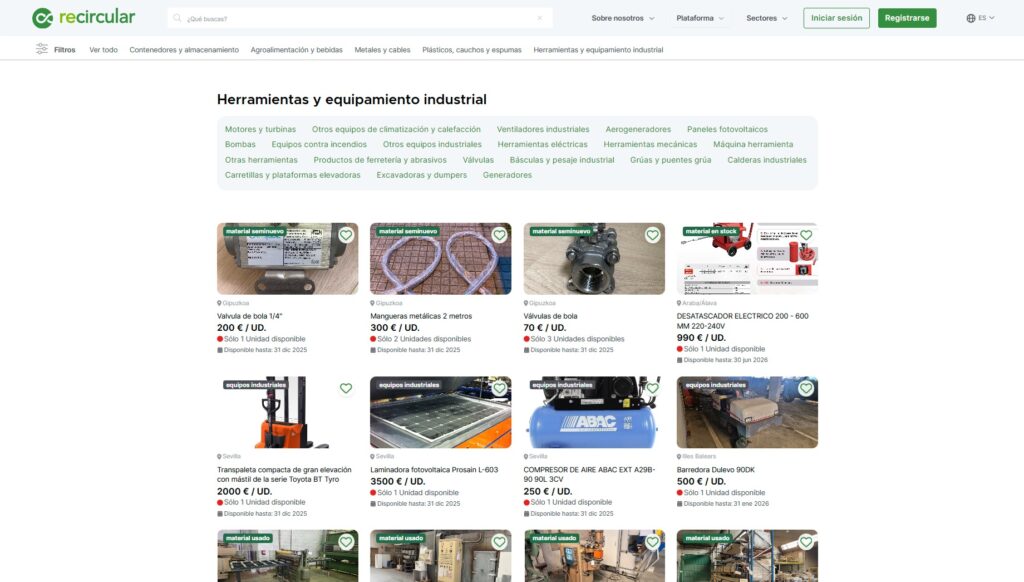
Source: Industrial tools and equipment available on the recircular platform (November, 2025).
You can start, for example, with a pilot project, selecting one or two types of equipment, a small batch, and clear metrics for performance, incidents, costs, and CO₂ emissions.
Then, based on the data obtained, decide whether to scale the model and make buying and selling used materials and equipment a core part of your business.
Buying used equipment reduces risks, costs, and environmental impact.
Purchasing used equipment is a strategic decision that combines cost savings, operational agility, and environmental responsibility.
Companies that integrate it into their operations are building competitive advantages that materialize in a lower cost structure, greater resilience to supply disruptions, and better positioning to meet increasingly stringent regulations.
Used materials and equipment are available, functional, and more accessible than many organizations realize.
All you have to do is look and click in recircular.
