Traceability in waste management: how to comply with legislation
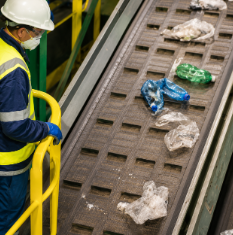
Talking about traceability in waste management is synonymous with trust, control, and environmental commitment.
Every company that generates, transports, or manages waste is part of a chain that, if not accurately documented, breaks down. And when it breaks down, risks arise: penalties, loss of valuable materials, and an environmental impact that is difficult to manage.
Law 7/2022, on waste and contaminated soils for a circular economy, has made this traceability a core obligation. A verbal commitment is no longer enough. It is necessary to demonstrate, with verifiable data, what is generated, where it goes, and how it is transformed.
In this new scenario, digitalization is no longer optional: it is the thread that connects the entire chain. At Recircular, and thanks to our platform, we help companies transform bureaucracy into action, waste into a resource, and legal obligation into a tangible opportunity for environmental leadership.
What does traceability in waste management consist of, and why is it so important?
Traceability in waste management is the procedure that allows tracking each material or resource from the moment it is generated until its final treatment or recovery, including all stakeholders in the chain.
This control, established in Law 7/2022, aims to ensure that all waste has a controlled and documented destination, preventing abandonment, improper mixing, or illegal dumping. In this way, it not only complies with the law but also fosters transparency and trust among the parties involved.
Traceability is also a quality tool, as Ecoembes points out. Processes are monitored by external entities and audited under ISO standards, guaranteeing reliability and rigor at every stage of recycling.
In short, this process is not just an administrative record. It is the backbone of modern, responsible waste management aligned with sustainability goals.
What does the Spanish regulatory framework establish regarding traceability in waste management?
The legal framework governing traceability is based on Law 7/2022, of April 8, on waste and contaminated soils for a circular economy, and Royal Decree 1055/2022, of December 27, on packaging and packaging waste.
Both regulations reinforce the principle of shared responsibility and the need to maintain comprehensive documentation for each waste stream.
What does Law 7/2022 say about traceability?
Law 7/2022 introduces traceability as a mandatory requirement for all companies that generate, transport, or manage waste, whether hazardous or non-hazardous. Title VI of the law establishes that each operator must maintain:
- a chronological file (Art. 64) in electronic format, provided that more than 10 tons of non-hazardous waste are generated annually. This file must contain information on the quantity, nature, origin, and destination of the waste, as well as the collection frequency, means of transport, and planned treatment method. This file must be kept for 5 years.
- Also required is documentation certifying the final destination of the waste.
Furthermore, the law promotes the digitalization of waste control through the Electronic System for Notifying Waste Transfers in Spain (eSIR), a platform developed by the Ministry for Ecological Transition and the Demographic Challenge (MITECO). This platform allows companies and autonomous communities to manage all aspects of waste movement within the country online: advance notices, identification documents, and notifications regarding the acceptance or rejection of waste. Its creation stems from Royal Decree 553/2020, which mandates that autonomous communities use this system or their own system through their electronic portals.
What does Royal Decree 1055/2022 say about traceability?
Royal Decree 1055/2022, for its part, complements this framework for packaging, reinforcing the role of Extended Producer Responsibility (EPR) schemes.
These organizations are responsible for ensuring that the packaging…roductores de envases cumplan con las obligaciones de recogida, reciclado y trazabilidad documental.

Obligations and Required Documentation Step by Step
Compliance with traceability in waste management depends on rigorous documentation and shared responsibility among all parties involved: producers, transporters, waste managers, intermediaries, agents, and traders.
Although some of the requirements were already discussed when talking about legal obligations and best practices for responsible waste management, it is worth analyzing the specifics of each link in the chain in more detail.
Producers: Responsibilities and Required Documentation
If producers are unable to carry out the treatment themselves (with the appropriate authorization, as stipulated in Article 20 of Law 7/2022), they must identify, classify, and deliver their waste to authorized traders or managers, formalizing a treatment contract that specifies the conditions of transport and acceptance.
Furthermore, they must issue and retain supporting documentation for at least three years, or five years depending on the type of waste.
Carriers: Traceability During Transport
Carriers must notify the regional government where their headquarters are located of the start of their operations, obtaining an Environmental Identification Number (NIMA) that appears on all transport documents.
During transport, they are required to carry the identification document (DI) issued by the transport operator (according to Royal Decree 553/2020) and keep a copy signed by the recipient upon delivery of the waste. These documents, along with the chronological record, ensure complete traceability of the movement.
Waste Managers: Closing the Documentation Cycle
Waste managers are those who carry out recovery or disposal operations and close the documentation cycle for the waste. They must have administrative authorization specifying the permitted operations (recovery, coded as "R," or disposal, coded as "D") and the EWC codes they are authorized to process.
When acting as transport operators, they must formalize a Treatment Contract (TC), submit the Prior Notification of Transfer where required, and complete the Identification Document (ID) before and after transport. They must also ensure that the carrier and the final recipient are authorized and maintain documentation electronically, through systems such as eSIR.
Each year, they submit an activity report to the regional government detailing the waste managed and its final destination, guaranteeing traceability and compliance.
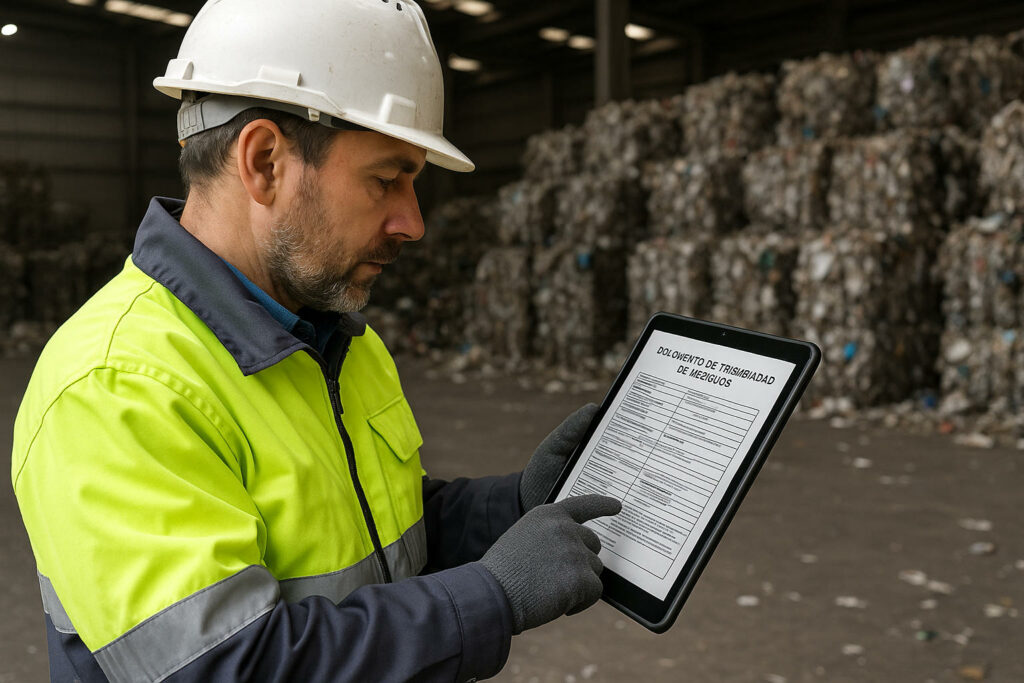
Agents and Traders: Control and Transparency
Agents and traders do not physically possess the waste, but they must ensure its traceability and authorized destination. Both require administrative authorization or registration and a NIMA number.
The agent acts on behalf of the producer or holder, while the trader buys and sells waste on their own behalf. In both cases, they must keep documentation that proves the treatment and final destination and submit an annual report to the administration.
These entities complement traceability by providing control and transparency in commercial operations within the circular economy.
Documentary Control and Digital Traceability
All documentation (contracts, identification documents, prior notifications, and reports) constitutes formal proof of legal compliance and must be kept for the minimum required period.
In practice, this management is usually carried out electronically through platforms such as eSIR, which allow the electronic transmission and validation of information between companies and public administrations, enabling authorities to access waste movements within the national territory in real time.
| Actor | Obligación principal (Artículo) | Documentación clave | Conservación |
|---|---|---|---|
| Productores | Identificar/clasificar; contrato de tratamiento (Ley 7/2022, Art. 20) | Archivo cronológico y justificantes | 3-5 años |
| Transportistas | NIMA; portar DI (RD 553/2020, Art. 6) | DI firmado y archivo cronológico | 3 años |
| Gestores | Autorización (R/D, LER); memoria anual (RD 1055/2022, Art. 49) | Contratos, DI, eSIR | 5 años |
| Agentes/Negociantes | Autorización/NIMA; memoria anual (Ley 7/2022, Art. 65) | Justificantes de destino | 3-5 años |
The role of recircular in waste traceability
Within the framework of this digital transformation, Recircular acts as a technology partner, translating regulations into operational tools.
Our model is based on a digital traceability solution that records every waste flow from its point of origin to its final destination. This allows for the generation of verifiable documentation that certifies compliance with Law 7/2022.
We also offer a collaborative digital management environment where producers, transporters, and waste managers can share and update documentation in real time. In this way, each actor in the chain has the necessary records to comply with legal obligations without duplication or delays.
To this end, our platform is integrated with Teixo to generate documentation related to waste management, treatment contracts, and identification documents, and even to communicate with the eSIR system.
Challenges and opportunities of traceability in waste management
Traceability in waste management is an increasingly transparent, demanding, and complex landscape.
Companies face a dual challenge: reducing their waste generation, complying with increasingly stringent regulations, and simultaneously transforming traceability into a genuine competitive advantage. Many SMEs, in fact, still perceive traceability as a bureaucratic burden rather than a tool.
But the shift in perspective is already underway. Companies that have adopted digital systems (such as eSIR or our platform) are discovering that traceability improves operational efficiency, facilitates audits, optimizes resources, and strengthens their environmental reputation.
The real challenge, therefore, is not only technological but also cultural.
Moving from minimal compliance to proactive circular management requires understanding that traceability in waste management is not a formality, but rather the starting point for a more efficient, transparent, and sustainable production model.
